

picaja
Stamgast
Meer info hier:
http://www.sonicprojects.ch/opxpro2/description.html
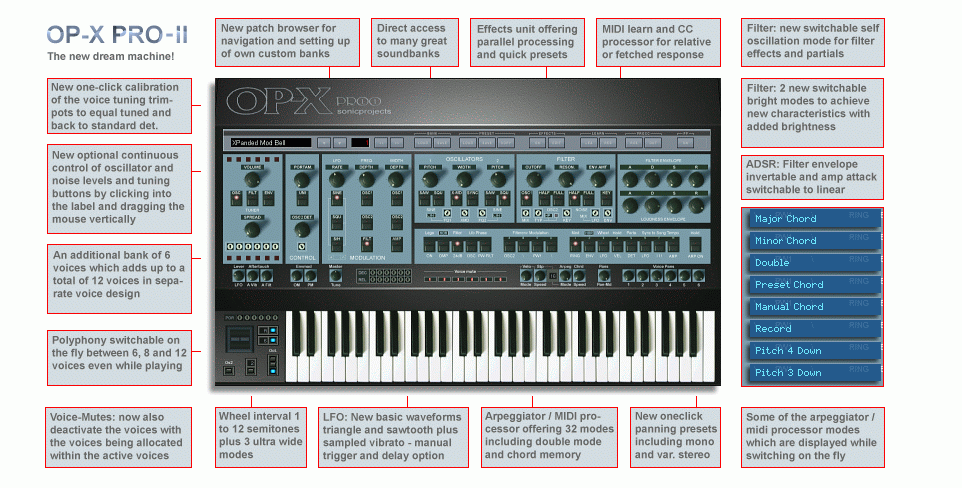
New features:
- doubled polyphony, switchable between 6, 8 and 12 voices
- voice mute section deactivates voices for custom polyphony info
- included patch browser with central saving location
- patch change smoothing using MIDI or incr/decr. buttons info
- a new extended library offering 1'500 (!) sounds
- can load all former OP-X PRO patches
- 128 istead of 64 patches per bank
- a built in effects unit offering delay and reverb
- dual engine option for effects finishing after preset change info
- a bunch of handy one-click effect presets
- delay syncable to host or arpeggiator (even / triple / dotted)
- a completely new arpeggiator/midi processor offering 32 modes info
- arpeggio hold/release switchable by damper-pedal info
- chord hold function and preset chords
- a switchable double mode for fat sounds info
- a simple 8 step note recorder
- 32 different pitchwheel/modwheel interval and function presets info
- MIDI learn supporting full MIDI feedback info
- blockable CC input/output
- switchable relative or fetched CC response info
- two new switchable bright modes info
- switchable filter self oscillation info
- new LFO waveforms sawtooth and triangle
- very slow LFO speed possible for triangle modulation
- LFO S/H switchable to sampled vibrato (using wheel LFO) info
- switchable LFO manual triggering with free phase adjust info
- switchable LFO delay with adjustable delay and rise time info
- switchable linear attack for amp envelope
- filter envelope invertable info
- optional seamless level control of noise and oscillators info
- optional seamless amount control of the tuning buttons
- quick one-click trimpot calibration for tuning trimpots info
- one-click filter trimpots zeroing for pure lowpass mode
- one-click center reset for master tune
- one-click zeroing for OM and PM knobs
- one-click panpot center reset for pure mono
- several one-click panpot setting presets
- common mono-to-stereo blending of the pans
- pan-modulation source switchable to wheel LFO info
- switchable triangle waves for oscillators info
- pitch adjust range of oscillator 1 enhanced to 5 octaves
- user manual featuring a GUI picture index
If you are new in the world of OP-X PRO you might have a look at the general features list to be able to find out if the features you're looking for are there:
General features:
- 2 oscillators featuring sawtooth, variable pulse, sine and triangle wave
- cross modulation, hard sync, ring modulation and sine fm
- quantized or seamless oscillator pitch adjust
- stacked unison mode (using 1-6 voices) with adjustable voice spread
- switchable legato mode (non-retrigger, last note priority)
- polyphonic portamento featuring portamento detuning
- 12 voices in separate voice design (SVD)
- polyphony globally switchable between 6/8/12
- voice deactivation option for custom polyphony settings (1, 2, 3, etc.)
- multimode filter (lopass 12/24db, hipass, bandpass, notch)
- seamlessly blendable filter modes (hipass->bandpass->notch)
- parallel dual filter design (lopass-multimode) featuring variable mix
- parallel filter mix modulatable by LFO and filter envelope
- SEM characteristic not loosing gain at high resonance settings
- switchable filter self oscillation
- variable key tracking (0-100%)
- filter envelope amount controllable by velocity
- ADSR filter envelope, invertable
- ADSR amp envelope, attack switchable to linear
- LFO featuring sine, square, triangle, sawtooth, sample&hold, sampled vibrato
- delay and manual trigger option for LFO
- LFO modulation streams invertable in two groups
- and additional modulation wheel LFO (sine only)
- filter envelope modulation to oscillator pitch and pulse width
- amp envelope modulation to ring modulation
- 32 different pitch/modulation wheel interval and function presets
- pitch wheel optionally routable only to oscillator 1
- switchable velocity to filter envelope amount
- arpeggiator featuring 32 modes, input or pitch order, random, 1-4 octaves
- arpeggio hold/release switchable by damper-pedal
- chord hold function
- 16 built in preset chords
- a switchable double mode for fat sounds
- a simple 8-step note recorder
- arpeggiator and LFO synchronizable to song tempo (even or triolic)
- built in effects unit offering reverb and delay
- switchable dual engine effects mode to keep effects finishing on preset change
- delay syncable to arpeggiator or host (even/triolic/dotted)
- effects unit switchable off with one button
- MIDI controller learn
- full MIDI CC feedback support for endless rotary controllers
- CC response switchable to relative or fetched to avoid value jumps
- Separate Voice Design (SVD) with an independent mono synth for each voice
- each voice has slightly deviating sound by default like in real analog synths
- rotating voice allocation for never repeating tone color
- voices globally tunable separatly for oscillators, filters, envelopes and portamento
- voice-based tuning trimpots for custom fine tunings of parameter groups
- voice individually deactivatable to have any voice of choice involved
- individual pan-pots for each voice channel allowing to place a voice in the stereo field
- pan-pots modulatable by LFO (main LFO or wheel LFO)
- built in sound library featuring 1'500 sounds in 32 banks
- sound library categorized (solos, strings, brass, bass, etc.)
- sound library featuring many famous 80ies sounds
- sound library featuring synth emulating banks (Jupiter-8, Prophet-5, Minimoog, etc.)
http://www.sonicprojects.ch/opxpro2/description.html
New features:
- doubled polyphony, switchable between 6, 8 and 12 voices
- voice mute section deactivates voices for custom polyphony info
- included patch browser with central saving location
- patch change smoothing using MIDI or incr/decr. buttons info
- a new extended library offering 1'500 (!) sounds
- can load all former OP-X PRO patches
- 128 istead of 64 patches per bank
- a built in effects unit offering delay and reverb
- dual engine option for effects finishing after preset change info
- a bunch of handy one-click effect presets
- delay syncable to host or arpeggiator (even / triple / dotted)
- a completely new arpeggiator/midi processor offering 32 modes info
- arpeggio hold/release switchable by damper-pedal info
- chord hold function and preset chords
- a switchable double mode for fat sounds info
- a simple 8 step note recorder
- 32 different pitchwheel/modwheel interval and function presets info
- MIDI learn supporting full MIDI feedback info
- blockable CC input/output
- switchable relative or fetched CC response info
- two new switchable bright modes info
- switchable filter self oscillation info
- new LFO waveforms sawtooth and triangle
- very slow LFO speed possible for triangle modulation
- LFO S/H switchable to sampled vibrato (using wheel LFO) info
- switchable LFO manual triggering with free phase adjust info
- switchable LFO delay with adjustable delay and rise time info
- switchable linear attack for amp envelope
- filter envelope invertable info
- optional seamless level control of noise and oscillators info
- optional seamless amount control of the tuning buttons
- quick one-click trimpot calibration for tuning trimpots info
- one-click filter trimpots zeroing for pure lowpass mode
- one-click center reset for master tune
- one-click zeroing for OM and PM knobs
- one-click panpot center reset for pure mono
- several one-click panpot setting presets
- common mono-to-stereo blending of the pans
- pan-modulation source switchable to wheel LFO info
- switchable triangle waves for oscillators info
- pitch adjust range of oscillator 1 enhanced to 5 octaves
- user manual featuring a GUI picture index
If you are new in the world of OP-X PRO you might have a look at the general features list to be able to find out if the features you're looking for are there:
General features:
- 2 oscillators featuring sawtooth, variable pulse, sine and triangle wave
- cross modulation, hard sync, ring modulation and sine fm
- quantized or seamless oscillator pitch adjust
- stacked unison mode (using 1-6 voices) with adjustable voice spread
- switchable legato mode (non-retrigger, last note priority)
- polyphonic portamento featuring portamento detuning
- 12 voices in separate voice design (SVD)
- polyphony globally switchable between 6/8/12
- voice deactivation option for custom polyphony settings (1, 2, 3, etc.)
- multimode filter (lopass 12/24db, hipass, bandpass, notch)
- seamlessly blendable filter modes (hipass->bandpass->notch)
- parallel dual filter design (lopass-multimode) featuring variable mix
- parallel filter mix modulatable by LFO and filter envelope
- SEM characteristic not loosing gain at high resonance settings
- switchable filter self oscillation
- variable key tracking (0-100%)
- filter envelope amount controllable by velocity
- ADSR filter envelope, invertable
- ADSR amp envelope, attack switchable to linear
- LFO featuring sine, square, triangle, sawtooth, sample&hold, sampled vibrato
- delay and manual trigger option for LFO
- LFO modulation streams invertable in two groups
- and additional modulation wheel LFO (sine only)
- filter envelope modulation to oscillator pitch and pulse width
- amp envelope modulation to ring modulation
- 32 different pitch/modulation wheel interval and function presets
- pitch wheel optionally routable only to oscillator 1
- switchable velocity to filter envelope amount
- arpeggiator featuring 32 modes, input or pitch order, random, 1-4 octaves
- arpeggio hold/release switchable by damper-pedal
- chord hold function
- 16 built in preset chords
- a switchable double mode for fat sounds
- a simple 8-step note recorder
- arpeggiator and LFO synchronizable to song tempo (even or triolic)
- built in effects unit offering reverb and delay
- switchable dual engine effects mode to keep effects finishing on preset change
- delay syncable to arpeggiator or host (even/triolic/dotted)
- effects unit switchable off with one button
- MIDI controller learn
- full MIDI CC feedback support for endless rotary controllers
- CC response switchable to relative or fetched to avoid value jumps
- Separate Voice Design (SVD) with an independent mono synth for each voice
- each voice has slightly deviating sound by default like in real analog synths
- rotating voice allocation for never repeating tone color
- voices globally tunable separatly for oscillators, filters, envelopes and portamento
- voice-based tuning trimpots for custom fine tunings of parameter groups
- voice individually deactivatable to have any voice of choice involved
- individual pan-pots for each voice channel allowing to place a voice in the stereo field
- pan-pots modulatable by LFO (main LFO or wheel LFO)
- built in sound library featuring 1'500 sounds in 32 banks
- sound library categorized (solos, strings, brass, bass, etc.)
- sound library featuring many famous 80ies sounds
- sound library featuring synth emulating banks (Jupiter-8, Prophet-5, Minimoog, etc.)


 maar mijn geoefend oor hoort weinig of geen verschil met de 'echte' hardware. Meestal klinken de filters te digitaal maar Peter weet duidelijk hoe de oberheim klinkt en heeft dit ook toegepast in zijn Vsti.


