
Install the app
How to install the app on iOS
Follow along with the video below to see how to install our site as a web app on your home screen.
Note: This feature may not be available in some browsers.
You are using an out of date browser. It may not display this or other websites correctly.
You should upgrade or use an alternative browser.
You should upgrade or use an alternative browser.
rca vs jack
- Thread starter bobaphat
- Start date

Hanz
Anonieme Analogist
Tja...
http://www.eetimes.com/electronics-...4033516/The-RCA-phono-plug-An-outdated-relic-
Originally introduced by the Radio Corporation of America in the 1940s to allow monaural phonographs to be connected to amplifiers, they later became widely adopted as a simple and inexpensive way to interconnect components in consumer audio (and later, video) systems. But was it a good choice?
While audio interconnects - especially the cables themselves - receive a good deal of attention from audiophiles who fret about such things as "skin effect" and wire and dielectric material, most audio design engineers recognize that the RCA connector itself is by far the more critical - and limiting - component. The parts suffer from several drawbacks:
1.) When making a connection, the ground connection is made *after* the signal connection (and vice versa when disconnecting). While this doesn't affect normal operation, if the connectors are connected/disconnected while the associated equipment is powered on this could result in amplifier and speaker damaging bursts of noise.
2.) Unlike the balanced connections used in most professional audio equipment, an RCA connection is unbalanced, resulting in more susceptibility to noise. While the typically shorter cable lengths used in consumer audio makes this less of an issue in most applications, noise is still a common enough problem that some might argue for balanced connections in consumer gear. But this would come at a cost - both in dollars and in circuit complexity.
3.) With RCA connectors, each signal requires a separate plug. This can obviously contribute to the familiar "rat's nest" of wiring, but in some cases can even create problems where the spacing of stereo input/output jacks on equipment is unable to accommodate some heavier-duty interconnects equipped with larger size cables and plugs.
4.) Some argue that the lack of a characteristic 75-ohm impedance is also an issue with RCA connectors. For analog audio this is hardly a problem, but for video and - maybe - digital audio, the point is more valid. In the latter case, almost all consumer digital audio equipment has adopted the use of the RCA connectors (along with the more expensive and less robust TOSLINK optical connector) for the S/PDIF interface - despite the fact that the interface standard calls for a 75-ohm impedance connection.
This could be achieved with 75-ohm BNCs, or even RF coaxial F-connectors, but no engineer familiar with transmission line design would specify an RCA connection here as an optimal solution. Ultimately, though, does it really matter? Not according to some, who point out that with a maximum bandwidth of about 12 MHz and a wavelength of about 10 ft, the S/PDIF signal simply won't be affected by typical RCA connector/cabling lengths. But the debate continues.
http://www.eetimes.com/electronics-...4033516/The-RCA-phono-plug-An-outdated-relic-

Hanz
Anonieme Analogist
Nee, consumers motten niet zoveel met een mixer. RCA wordt veel gebruikt in broadcast en voor DJ dingen, dus vandaar zal je het veel aantreffen.
Dat het een onhandig formaat is ben ik met je eens, maar zelfs de mooiste broadcast mixers van bijv. Studer / Revox zitten er vol mee, dat degradeert ze niet meteen tot consumer crap...
Dat het een onhandig formaat is ben ik met je eens, maar zelfs de mooiste broadcast mixers van bijv. Studer / Revox zitten er vol mee, dat degradeert ze niet meteen tot consumer crap...
Hanz
Anonieme Analogist
Waarom open je dan uberhaupt een topic over RCA vs jack en ga je niet gewoon meteen die Zed afpissen...


bobaphat
Ouwe rot
- Lid sinds
- 19 Maart 2002
- Berichten
- 3.328
Waarom open je dan uberhaupt een topic over RCA vs jack en ga je niet gewoon meteen die Zed afpissen...
omdat ik eerst wil weten hoe bout RCA is voordat ik de Zed af ga zeiken


Nisei
Ouwe rot
- Lid sinds
- 26 september 2002
- Berichten
- 1.748
1.) vind ik een beetje vage opmerking. Als je een jack inplugt zit je eerst je signaal met de aarde te verbinden. Ik plug liever een tulp in terwijl m'n volume open staat dan een jack. Er zijn niet voor niks silent jack pluggen met een magneetschakelaar die pas schakelt als de plug er helemaal in is geduwd.

Vic
Soldeerprofeet
Beshouw die RCA net als een unbalanced jack, maakt geen moer uit.
Goede kwaliteit kabels kopen/maken en niet kloten met verloopjes.
Laat je niets wijsmaken, rca is ok
Goede kwaliteit kabels kopen/maken en niet kloten met verloopjes.
Laat je niets wijsmaken, rca is ok


sunny pedaal
ALL (Anna Loog Lid)
ik soldeer liever een jack dan dat gepiel met een rca.
ook is de klemming van de kabel bij jack beter/sterker, je trekt hem er dus minder makkerlijk vanaf/ steviger
heb zelf een soundtracs tafel die zowel jack alsook rca heeft , dat was ook zo bij de tascamtafels die ik had.
voor de geluidskwaliteit maakt het volgens mij niet uit, wel voor de betrouwbaarheid en zelf-repareerbaarheid
ook is de klemming van de kabel bij jack beter/sterker, je trekt hem er dus minder makkerlijk vanaf/ steviger
heb zelf een soundtracs tafel die zowel jack alsook rca heeft , dat was ook zo bij de tascamtafels die ik had.
voor de geluidskwaliteit maakt het volgens mij niet uit, wel voor de betrouwbaarheid en zelf-repareerbaarheid

RCA wordt veel gebruikt in broadcast en voor DJ dingen, dus vandaar zal je het veel aantreffen.
Broadcast en dj dingen zijn wel heel verschillend, broadcast werkt volgens de hoogste normen, en is niet te vergelijken met 'dj dingen'.
Hanz
Anonieme Analogist
Maar ze gebruiken/gebruikten allebei wel een behoorlijke mate van RCA stekkers, dat was m'n punt.
Vic
Soldeerprofeet
CD spelers, platen spelers etc 

Hanz
Anonieme Analogist
Maar het is niet waar, probeer jij in een broadcast omgevin maar een rca-tje te vinden. Altijd XLR en anders mischien lemo, maar nooit rca, op welk apparaat zou dat moeten zitten dan.....
Studer A779

Sony MXP serie
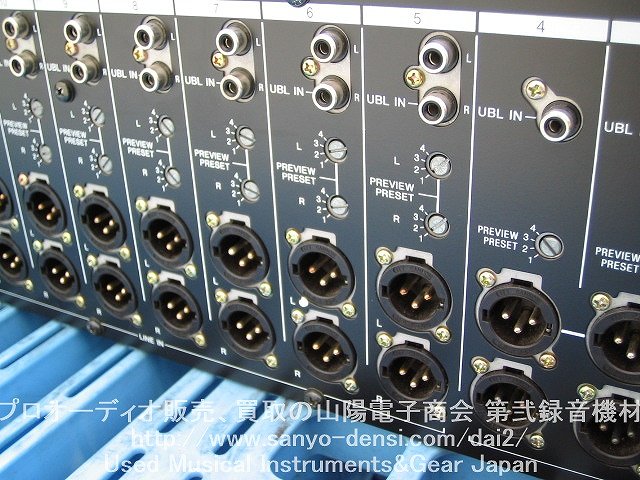
Dat soort spul bedoel ik Tactic.

cybermax
SYNTHESIZER SPECIALIST
Als een regeltafelfabrikant met een model voor de semi-prof wereld kampt met ruimte en kosten-problematiek op de achterzijde en het uitgangsnivo op -10 wordt uitgevoerd kiest hij voor RCA ipv Jack.
Professionele tafels of broadcast tafels hebben soms XLR maar vaker nog grote multiconnectors, omdat die toch met een patchveld worden verbonden voor de aansluitingen en deels vast worden bedraad.
Als er RCA op zit is het per definitie GEEN pro-end tafel omdat RCA lijnsignalen op -10 heeft en dat dus niet voldoet voor pro-end randapparatuur.
RCA is kwalitatief prima als connector voor hifi sets en kleine "muziek installaties" op semi prof nivo.
Zodra je echter een grote studio bouwt met RCA krijg je enorme problemen met aardlussen en brom en ruis problematiek als je niet weet wat je doet.
Lange kabels kunnen NIET met RCA en ook niet met JACK, daarvoor is GEBALANCEERD XLR de DE-FACTO standaard.
De ECHTE broadcast wereld (niet de lokale omroep...) heeft als GEEN ANDER te maken met lange verbindingslijnen van en naar onderlinge studio's, edit ruimten, spreekcellen en natuurlijk het zenderpark.
Als DAAR RCA zou worden toegepast zou radiomaken een ware HEL worden.
Professionele tafels of broadcast tafels hebben soms XLR maar vaker nog grote multiconnectors, omdat die toch met een patchveld worden verbonden voor de aansluitingen en deels vast worden bedraad.
Als er RCA op zit is het per definitie GEEN pro-end tafel omdat RCA lijnsignalen op -10 heeft en dat dus niet voldoet voor pro-end randapparatuur.
RCA is kwalitatief prima als connector voor hifi sets en kleine "muziek installaties" op semi prof nivo.
Zodra je echter een grote studio bouwt met RCA krijg je enorme problemen met aardlussen en brom en ruis problematiek als je niet weet wat je doet.
Lange kabels kunnen NIET met RCA en ook niet met JACK, daarvoor is GEBALANCEERD XLR de DE-FACTO standaard.
De ECHTE broadcast wereld (niet de lokale omroep...) heeft als GEEN ANDER te maken met lange verbindingslijnen van en naar onderlinge studio's, edit ruimten, spreekcellen en natuurlijk het zenderpark.
Als DAAR RCA zou worden toegepast zou radiomaken een ware HEL worden.

dubcreator
Ouwe rot
- Lid sinds
- 7 mei 2009
- Berichten
- 1.675
Broadcast tafels hebben meestal geen gebalanceerde inputs. Sterker nog ... ze voeren vaak wel een xlr input op de broodjes maar dan is het stereo op een xlr. Middelste pin is ground en de andere 2 voor L/R. Alleen de mic inputs zijn gebalanceerd. Multi connectors als EDACs kom je alleen tegen op pro studio concoles die naar een TT patchbay gaan. Op sommige kleinere broadcast tafels kom je wel multi connectors tegen maar zijn dan meestal SubD connectors waar alle input/output/on airlamp etc,etc op zitten. File transfers bij broadcast gaan gewoon via een netwerk en geen audio.
Vergelijkbare discussies

- Reacties
- 53
- Bekeken
- 7K
- Reacties
- 110
- Bekeken
- 11K

Delen: