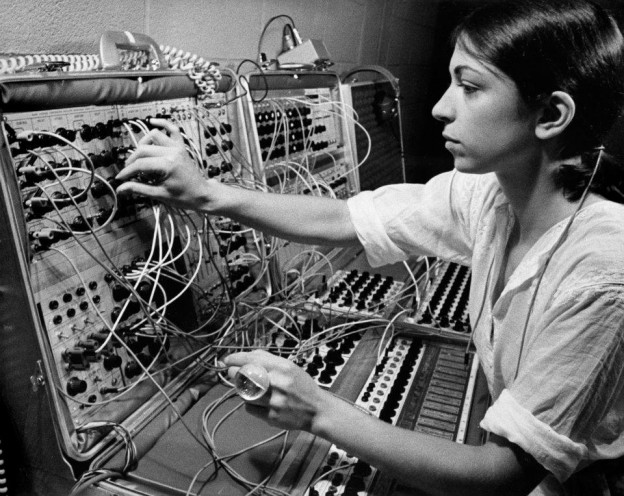
The Art of Electronics

Woensdag 20 november om 23:00 trakteert Electronic Frequencies u op een groot aantal originele theremin composities. En de dag er na, op 21 november, passeren in Pakrammel elektronische klankpareltjes uit de jaren '70.

http://www.concertzender.nl/van-theremin-naar-the-electronic-seventies/?Voorpagina=true

suzanne_ciani-624x496.jpg
 
Bericht door een moderator:
In overleg, offtopic berichten verwijderd . En op verzoek van topicstarter graag ontopic reacties b.v.d
In mijn ogen zou er eventueel sprake kunnen zijn dat jij dat overleg was gestart.
Vat het niet persoonlijk op, ik heb ervaringen met bepaalde types die mij voorheen
uit jaloezie buitenspel hadden gezet, omdat ze zelf amper wat waar konden maken.
Denk jij dat al die grote revolutionaire synthesizerariesten het waar hadden kunnen
maken als er met ieder wissewasje werd afgerekend i.v.m. of er iets wel of niet gebruikelijk was geweest?
Mijn reakties waren sowieso stuk voor stuk onschuldig, ook was het nog eens een keer zo dat ik in mijn vorige laatste reaktie een vraag had geplaatst hoe het met Roland en zijn bezigheden ging om het voor hem gemoedelijk proberen te maken omdat er iemand een beetje met een hork uitstraling een reaktie plaatste en heb jij vervolgens het lef om mijn geplaatste reakties en interssante reakties die door Roland voor mij geplaatst waren te verwijderen.
Dit Straalt smakeloos uit!
En dan nog het volgende:
Ik had het over mijn gedreven enthousiasme betreffende Ryoji Ideka d.m.v. het idee te hebben als ik op het testpattern zeg :Ryoji, stuur me aan en mede i.v.m dat gedreven aan de slag te willen gaan.
Ook had ik het een keer over dat poolpositie een mooi verlangen is, maar dat men zijn deelnemerspositie niet moet vergeten anders raakt men geobsedeerd gefixeerd op de poolpositie, dit geldt mede parallel voor het synth gebeuren, d.m.v. die redenatie had ik in mijn beginperiode toen ik heel snel groeide met ontplooien mensen met kennis netjes gezegd boven hun verwachtingen kunnen verassen.
Daarbij sta ik voor alles open wat essentieel met gevoel is geproduceerd in dit vak, als ik daarbij een voorbeeld zou moeten geven voor een idee: Het combineren van de structuur van Kraftwerk - Computer world met het spanningsveld van de klanken van Alphaville - Forever young toe te voegen met een soort parallel gelijk schema en produktief de extra klanken er in te bewerkstelligen op basis van de werkwijze van Ryoji Ideka, plus de voorbeelden die ik gaf waarmee ik voorheen resultaat heb kunnen boeken, ben ik dan soms degene die meer offtopic bezig is??...om maar even duidelijk te maken dat mede ik het in het vak niet bij het verkeerde eind heb.
Roland, Suzanne Ciani is in ieder geval wel weer een interessante ontdekking.
Ik vraag enkel in te zien dat ik ook tel, en ik denk dat ik dat vooral aan jou vraag, Hilltree, bedankt.
Groet,
 
In deze uitzending 1 van haar 'klankpareltjes'.
Net even een oud stukje "Sound of Wetness" afgeluisterd op haar website. Klinkt prima. Natuurlijk maakt een mens ontwikkelingen door maar onbegrijpelijk dat ze tegenwoordig die kleffe kitsch de wereld inslingert.

Sorry, moest dit even kwijt, indien het als off-topic wordt ervaren: verwijderen maar.
 
Met deze draad, heb ik voor ogen een onafhankelijke draad over de geschiedenis van de elektronische muziek neer te zetten, Hiernaast ook belangrijke studio's en notatie te bespreken.
Voor mij is het ook moeilijk om zonder sentiment of waarde oordeel zaken hier te plaatsen. Maar ik voel mij dus ook verplicht om hier muziek (en dergelijke) hier te plaatsen waar ik soms totaal niets mee heb en soms zelfs verwerp.
Toch zal ik dat gaan doen omdat het moet.
De discussies zie ik dan ook graag zonder waarde oordeel maar liever inhoudelijk.
Bijvoorbeeld over de gebruikte apparatuur of andere wetenswaardigheden over desbetreffende componist/pionier.
Wanneer mensen enthousiast worden van deze draad juich ik dat natuurlijk toe.
Graag zou ik zien dat verder al het persoonlijke achterwege gelaten wordt omdat niets te maken heeft met de hier geplaatste pioniers.
 
Laatst gewijzigd:
Bernard Parmegiani
(born 27 October 1927 in Paris, France) is a composer best known for his electronic or acousmatic music.

file.php


Between 1957 and 1961 he studied mime with Jacques Lecoq, a period he later regarded as important to his work as a composer. He joined the Groupe de Recherches Musicales (GRM) in 1959 for a two-year master class, shortly after its founding by Pierre Schaeffer. After leaving his studies with Lecoq, he was first a sound engineer and was later put in charge of the Music/Image unit for French television (ORTF). There he worked in the studio with several notable composers, Iannis Xenakis, for example

He composed his first major work, Violostries for violin and tape in 1964 for a choreography performed for Théâtre Contemporain d’Amiens directed by Jacques-Albert Cartier. During a visit to America in the late 1960s, he researched the link between music and video and on his return produced several musical videos, including L'Œil écoute, and L’Écran transparent (1973) during a residency at Westdeutscher Rundfunk in Germany. In the 1970s he also became involved with live performances of jazz and performed with the Third Ear Band in London.

At this time he also started writing acousmatic pieces for performance in the concert hall: examples are Capture éphémère of 1967 which deals with the passage of time, and L'Enfer (1972), a collaboration with the composer François Bayle, based on Danté's Divine Comedy.

In 1992 Parmegiani left the GRM and set up his own studio in Saint Remy. In April 2010 he sat on the jury at the sixth Qwartz Electronic Music Awards, a promotional project and support group for electronic music artists.
Parmegiani has been cited as a major influence by younger experimentalists like Aphex Twin, Autechre and Sonic Youth. Works of his were performed at the All Tomorrow's Parties festivals in 2003 and 2008.(Wiki)

Bernard Parmegiani - De Natura Sonorum, 1975:
http://youtu.be/c_JHjUFfOs8
 
Douglas Gordon Lilburn
(2 November 1915 – 6 June 2001) was a New Zealand composer.

file.php


Lilburn was born in Wanganui. He attended Waitaki Boys' High School from 1930 to 1933, before moving to Christchurch to study journalism and music at Canterbury University College (then part of the University of New Zealand) (1934–36). In 1937 he began studying at the Royal College of Music, London. He was tutored in composition by Ralph Vaughan Williams and remained at the College until 1939.
Lilburn returned to New Zealand in 1940 and served as guest conductor in Wellington for three months with the NBS String Orchestra. He shifted to Christchurch in 1941 and worked as a freelance composer and teacher until 1947. Between 1946 and 1949 and again in 1951, Lilburn was Composer-in-Residence at the Cambridge Summer Music Schools.
During these years he was heavily involved in New Zealand arts activity, and became friends with other artists such as Allen Curnow, Denis Glover, Rita Angus, and Alistair Campbell.
In 1947, Lilburn shifted to Wellington to take up a position at Victoria University as part-time lecturer in music. He became a full-time lecturer in 1949, senior lecturer in 1955, was appointed Associate Professor of Music in 1963 and Professor with a personal chair in music in 1970. Following visits to studios in Europe and Canada in 1963, Lilburn founded the electronic music studio at the university—the first in Australasia—in 1966 and was its director until 1979, a year before his retirement.
Lilburn was awarded an Honorary Doctorate from the University of Otago in 1969 and in 1978 was presented with the Citation for Services to New Zealand Music by the Composers' Association of New Zealand. On 6 February 1988, Lilburn was the eightth appointee to The Order of New Zealand.(Wiki)

Douglas Lilburn: Fragments Of A Poem:
http://youtu.be/czO0XxvRCGA
 
Ivo Malec
(born 30 March 1925, Zagreb) is a Croatian born French[1] composer, music educator and conductor. One of the earliest Yugoslav composers to obtain high international regard, his works have been performed by symphony orchestras throughout Europe and North America.
Coming from a rather 'classical' background, he met Pierre Schaeffer whom he considers his 'true and only master'; Schaeffer's teachings turned Malec into one of the most important leaders of the Groupe de recherches musicales. Since then he dedicated himself to a more radical style. He received a number of awards including the Grand Prix National de Musique in 1992. He is resident in France since 1955 and taught at the Paris Conservatoire from 1972 to 1990 where he taught composers such as Edith Canat de Chizy, Denis Dufour, Philippe Hurel, Philippe Leroux and Gerard Pesson.

Malec's approach to composition which in ways is similar to that of Denis Dufour or Xenakis is the emphasis on all aspects of sound including texture, density, movement, timbre and notably sonic character and form and the use of sound objects(wiki).

Ivo Malec - Bizzara(1972):
http://youtu.be/uAfm30xPHjo
 

Attachments

  • Ivo Malec.jpg
    Ivo Malec.jpg
    12,7 KB · Bekeken: 162
Hey Roland,

Wat een gave draad is dit! Uren lees- en luisterplezier. Ik ontdek'm nu pas!

Thanks voor het dellen!!
 
Werner Kaegi
Werner Kaegi (born June 17, 1926) is a Swiss electronic music composer, musicologist and educator. During the 1960s, he promoted electronic music in his home country. In the 1970s, as a composer and researcher at Utrecht's Institute of Sonology, The Netherlands, he developed pioneering programs in the field of computer-generated music.

Kaegi was born in Uznach, in the St. Gallen canton. He studied mathematical logic and music in Zürich, Heidelberg and Basel, and music composition in Zürich, Basel, Salzburg and Paris. His music teachers have included composers Paul Hindemith, Arthur Honegger and Louis Aubert. In 1951, blending his interests for mathematics and music, he received his doctorate with a study of the structure of Johann Sebastian Bach's Inventions and Fugues.

Kaegi discovered Pierre Schaeffer, musique concrète and the GRM radio broadcasts in Paris in 1951, yet his 1950s compositions are for traditional instruments; Ariadne in Zürich is for clarinet and piano 4 hands, Miniaturen, for oboe, bassoon and cimbalom, while the 1956 Sonate is for clarinet and piano. During the next decade, however, Werner Kaegi embraced electronic music and became a pioneer of Swiss electroacoustic music, predating other composers in the field, such as Bruno Spoerri and Rainer Boesch.

At Centre de Recherches Sonores (1963–1970)

From 1963 to 1970, Kaegi worked at the Centre de Recherches Sonores, the electroacoustic music studio of Radio Suisse Romande in Geneva. There he started composing electronic and tape music, including pieces such as Éclipses (1964), L'Art de la Table (1964), and Entretiens (1965). At the C.R.S., Kaegi created several radiophonic works; such as La Porte Noire in 1964 and Zéa in 1965. In the late 1960s, Kaegi wrote several essays on electronic music, including the influential book Was ist elektronische Musik?, ("What Is Electronic Music?"), which was published in 1967 in Zurich, Switzerland, and also became a film for Swiss television.

This period of electronic music championing culminated in 1971 with the publication of Kaegi's unique record release, a 7-inch record titled Von Sinuston zur elektronischen Musik ("From Sine Wave to Electronic Music"). In the 12 pages accompanying booklet, Kaegi analyses the basic constituents of electronic music like sine wave, sound synthesis, ring modulation or electronic oscillator, with sound examples provided on the disc as well as excerpts from his most recent works of the time, Kyoto, 1970, Thai Clarinet, 1970, Hydrophonie I, 1969 and Illumination Expo'70 Osaka, 1969. The latter piece was commissioned by the Swiss government to be used as background music for the Swiss pavilion at the World Expo '70 in Osaka, Japan, a project he undertook with composer and contemporary music promoter André Zumbach (born 1931), then head of music at Radio Suisse Romande.

At Instituut voor Sonologie (1971–1987)

In 1969, Kaegi was invited to compose at Utrecht's Institute of Sonology, formerly known as STEM, in The Netherlands, where he created the tape music of Hydrophonie I. Owing to a grant from the Swiss government, he permanently relocated to The Netherlands in 1971 to work at the Institute and soon became a member of the board of directors. At the Institute, Kaegi worked as a composer, researcher and teacher in the field of electronically generated music and composition – his students have among others included Benno Ammann, Lasse Thoresen, Jos Janssen, Cort Lippe, Kathleen St John, Trevor Batten. Canadian composer Paul Goodman, born 1955, became his assistant in the 1980s.

Between 1973 and 1978, together with Dutch researcher Stan Tempelaars (1938–2010), Kaegi developed the VOSIM program. VOSIM, which stands for VOice SIMulator, is a system based on the digital sound synthesis of simple, sinusoidal square waves, allowing the modeling of vowel sounds, vocal fricatives and quasi-instrumental tones.[14] It complemented, and was used in conjunction with, Gottfried Michael Koenig's own computer-generated music programs Project 1 (1964), Project 2 (1966) and SSP (1971). Werner Kaegi summed up the VOSIM system in 1986 in a presentation for the scientific journal Interface.

In 1987, Kaegi was awarded a prize at the 15th Bourges international electroacoustic competition, in Bourges, France, for his piece Ritournelles, for soprano and VOSIM software.[15] He apparently ceased teaching and composing after 1987.(Wiki)

Youtube:


Attachments

  • Kaegi.png
    Kaegi.png
    38,3 KB · Bekeken: 149
Joel Chadabe
Joel Chadabe, composer, author, is an internationally recognized pioneer in the development of interactive music systems. He has concertized widely since 1969, with Jan Williams, Bruno Sperri, and other musicians, presenting his music at venues and festivals such as Klangprojektionen 4.4 (Vienna), Ear to the Earth (New York City), Computing Music IV (Cologne), HörZeit-SpielRaum 2005 (Berlin), ISCM Festival (Miami), NYU Interactive (NYC), New Mix (Palais de Tokyo, Paris), Chelsea Art Museum (New York), Expanded Instruments Festival (Engine 27, New York City), Centro Cultural Recoleta (Buenos Aires), Venice Biennale, Wellington Festival (New Zealand), Aarhus Festival (Denmark), De Isbreker (Amsterdam), New Music America, Inventionen (Berlin), IRCAM (Paris), Stedelijk Museum (Amsterdam), Ars Electronica (Linz, Austria), Electronic Music Festival (Stockholm), and New Music New York. His music is recorded on EMF Media, Deep Listening, CDCM, Centaur, Lovely Music, Opus One, CP2, and Folkways labels.

As president of Intelligent Music from 1983-1994, he was responsible for the development and publication of a wide range of innovative and historically important software, including M and Max, as well as the TouchSurface, an xyz touch-sensitive computer input device. In 1977, with Roger Meyers, he co-authored The PLAY Program, the first software sequencer. In 1967, while director of the Electronic Music Studio at State University of New York at Albany (1965 - 1998), he designed the CEMS (Coordinated Electronic Music Studio) System, an analog-programmable electronic music system, and commissioned Robert Moog to build it.

He was keynote speaker at the NIME (New Interfaces for Musical Expression) Conference in 2002 in Dublin, sponsored by the MIT Media Lab; at the International Computer Music Conference in Berlin in 2000; and at the International Music and Technology Conference (University of Melbourne, Australia, 1981), where he first coined the term 'interactive composing'. He has presented papers at EMS05 (Montreal), Resonances (IRCAM, Paris), Intersens (Marseilles), ISEA98 (Liverpool), at several SEAMUS and ICMC conferences, and at many other conferences; participated in panels at WISP (Sydney), ICMC 05 (Barcelona), and at many other conferences and symposia; and presented lectures, workshops, and demonstrations at Florida International University, IRCAM, Zurich Conservatory, Brown University, Experience Music Project (Seattle), University of Californa at Santa Barbara, CCMIX (Paris), University of California at San Diego, and at many other universities and venues. He has received awards, fellowships, and grants from the National Endowment for the Arts, New York State Council on the Arts, Ford Foundation, Rockefeller Foundation, Fulbright Commission, SUNY Research Foundation, New York Foundation for the Arts, and other foundations. He was the winner of the Grossen Preises der Ars Electronica, 2nd Prize (Linz, Austria, 1982), and he is the recipient of the 2007 SEAMUS Lifetime Achievement Award.

As author, his book 'Electric Sound: The Past and Promise of Electronic Music', published by Prentice Hall in November 1996, is the first comprehensive overview of the history of electronic music. His articles on electronic music have appeared in Organized Sound, Leonardo, Computer Music Journal, Contemporary Music Review, Leonardo, Journal of New Music Research, Leonardo Music Journal, Electronic Musician, Perspectives of New Music, Electronic Music Review, Melos, Musique en Jeu, and many other journals and magazines, and several of his articles have been anthologized in books by MIT Press, Routledge, Feltrinelli, and other publishers.

Mr. Chadabe has a B.A. degree from the University of North Carolina at Chapel Hill and an M.M. degree from Yale University, where he studied composition with Elliott Carter. He is currently Professor Emeritus at State University of New York at Albany; Director of the Computer Music Studio at Manhattan School of Music; Visiting Faculty at New York University; and Founder and President of Electronic Music Foundation, a not-for-profit organization that organizes concerts and other events and disseminates information and materials relating to the history and current practice of electronic music.

Distant Voices:
 

Attachments

  • chadabe.jpg
    chadabe.jpg
    58,3 KB · Bekeken: 154
Ernst Krenek
(August 23, 1900 – December 22, 1991) was an Austrian, later American, composer of Czech origin. He explored atonality and other modern styles and wrote a number of books, including Music Here and Now (1939), a study of Johannes Ockeghem (1953), and Horizons Circled: Reflections on my Music (1974). Krenek wrote two pieces using the pseudonym Thornton Winsloe.

The jazz-influenced score of Jonny spielt auf and its central character of a black jazz musician (who is also seen womanising and stealing a priceless violin) brought Krenek the opprobrium of the nascent Nazi Party; the image of Jonny was distorted to form the centrepiece of the poster advertising the Entartete Musik exhibition of so-called 'degenerate' music in 1938. Krenek was frequently named as a Jewish composer during the Third Reich, although he was not, and was intimidated by the regime until his emigration; on March 6, 1933, one day after the election in which the Nazis gained control of the Reichstag, Krenek's incidental music to Goethe's Triumph der Empfindsamkeit was withdrawn in Mannheim, and eventually pressure was brought to bear on the Vienna State Opera, which cancelled the commissioned premiere of Karl V.

In 1938 Krenek moved to the United States, where he taught music at various universities, the first being Vassar College. He later taught at Hamline University in Saint Paul, Minnesota from 1942 to 1947. There he met and married his third wife, his student and composer Gladys Nordenstrom. He became an American citizen in 1945. He later moved to Toronto, Canada, where he taught at The Royal Conservatory of Music during the 1950s. His students included Milton Barnes, Lorne Betts, Samuel Dolin, Robert Erickson, Halim El-Dabh, Richard Maxfield, Will Ogdon, and George Perle. He died in Palm Springs, California, where he had lived since 1966. In 1998 Gladys Nordenstrom founded the Ernst Krenek Institute; in 2004 the private foundation moved from Vienna to Krems, Austria.(Wiki)

Krenek's music is in a variety of styles. His early work is in a late-Romantic idiom, showing the influence of his teacher Franz Schreker. He later embraced atonality, but a visit to Paris, during which he became familiar with the work of Igor Stravinsky and Les Six, led him to adopt a neo-classical style. His opera Jonny spielt auf (Johnny Strikes Up, 1926), which is influenced by jazz, was a great success in his lifetime, playing all over Europe. In spite of Nazi protests, it became so popular that even a brand of cigarettes, still on the market today in Austria, was named "Johnny". He then started writing in a neo-Romantic style with Franz Schubert as a model, with his Reisebuch aus den österreichischen Alpen as prime example, before using Arnold Schoenberg's twelve-tone technique; the opera Karl V (1931-33) is entirely written using this technique, as are most of his later pieces. In the Lamentatio Jeremiae prophetae (1941–42) he combined twelve-tone writing with 16th century techniques of modal counterpoint. He also composed electronic and aleato(from an interview here: http://www.bruceduffie.com/krenek2.html )

Ernst Krenek op. 152 (1956) pt 1-Spiritus Intelligentiae Sanctus:
http://youtu.be/XpwnuuD6mFk
 

Attachments

  • kren2.jpg
    kren2.jpg
    20 KB · Bekeken: 158
Electronic Music Studios (EMS)
Is a synthesizer company formed in 1969 by Peter Zinovieff, Tristram Cary and David Cockerell.

The partners had wide experience in both electronics and music. Cockerell, who was EMS' main equipment designer in its early years, was a gifted electronics engineer and computer programmer. In the mid-1960s Zinovieff (who originally qualified as a geologist) had formed the pioneering electronic music group Unit Delta Plus with Delia Derbyshire and Brian Hodgson of the BBC Radiophonic Workshop. Cary was a noted composer and a pioneer in electronic music—he was one of the first people in the UK to work in the musique concrete field and built one of the country's first electronic music studios; he also worked widely in film and TV, composing scores for numerous Ealing Studios and Hammer Films productions, and is he well known for his work on the BBC's Doctor Who, notably on the classic serial The Daleks.(Wiki)

The studio as it was circa 1970. The studio was originally built in a shed at the end of the garden of 49 Deodar Road, Putney, overlooking the River Thames.
 

Attachments

  • EMS.jpg
    EMS.jpg
    73,6 KB · Bekeken: 143
Back
Top