The Art of Electronics

Henry Jacobs a pioneer of sound art.
(born October 9, 1924)

In 1952, Jacobs returned to Chicago and began experimenting with reel to reel tape recorders, taking particular advantage of the ease with which they made it possible to manipulate sound directly. Ambient, everyday sound, and especially the structural variety of apparently spontaneous sounds, interested him; at one point he ventured to Haiti to make street recordings. While attending graduate courses at the University of Illinois, he also produced a regular program on the campus radio station (WILL) entitled Music and Folklore, which is believed by some to be one of the first presentations of "world music" to an American audience.

Moe Asch, the founder of Folkways Records, offered Jacobs the opportunity to release his first record, Radio Programme No 1 Audio Collage: Henry Jacobs’ Music and Folklore, in 1955.

In 1957, working with artist Jordan Belson, Jacobs produced Vortex: Experiments in Sound and Light - a series of concerts featuring new music, including some of Jacobs' own, and that of Karlheinz Stockhausen, and many others - taking place in the Morrison Planetarium in Golden Gate Park, San Francisco. Sound designers commonly regard this as the origin of the (now standard) concept of "surround sound." The program was popular, and Jacobs and Belson were invited to reproduce it at the 1958 World Expo in Brussels.(Wiki)

Henry Jacobs - Electronic Kabuki Mambo, 1959:
http://youtu.be/MKbzWnw1FxY
 

Attachments

  • henryjacobs.jpg
    henryjacobs.jpg
    18,2 KB · Bekeken: 156
Bernard Parmegiani
(born 27 October 1927 in Paris, France) is a composer best known for his electronic or acousmatic music.

Between 1957 and 1961 he studied mime with Jacques Lecoq, a period he later regarded as important to his work as a composer. He joined the Groupe de Recherches Musicales (GRM) in 1959 for a two-year master class, shortly after its founding by Pierre Schaeffer. After leaving his studies with Lecoq, he was first a sound engineer and was later put in charge of the Music/Image unit for French television (ORTF). There he worked in the studio with several notable composers, Iannis Xenakis, for example

He composed his first major work, Violostries for violin and tape in 1964 for a choreography performed for Théâtre Contemporain d’Amiens directed by Jacques-Albert Cartier. During a visit to America in the late 1960s, he researched the link between music and video and on his return produced several musical videos, including L'Œil écoute, and L’Écran transparent (1973) during a residency at Westdeutscher Rundfunk in Germany. In the 1970s he also became involved with live performances of jazz and performed with the Third Ear Band in London.

At this time he also started writing acousmatic pieces for performance in the concert hall: examples are Capture éphémère of 1967 which deals with the passage of time, and L'Enfer (1972), a collaboration with the composer François Bayle, based on Danté's Divine Comedy.

In 1992 Parmegiani left the GRM and set up his own studio in Saint Remy. In April 2010 he sat on the jury at the sixth Qwartz Electronic Music Awards, a promotional project and support group for electronic music artists.
Parmegiani has been cited as a major influence by younger experimentalists like Aphex Twin, Autechre and Sonic Youth. Works of his were performed at the All Tomorrow's Parties festivals in 2003 and 2008.(Wiki)

Bernard Parmegiani - De Natura Sonorum, 1975:
http://youtu.be/c_JHjUFfOs8
 

Attachments

  • inac101213detail.jpg
    inac101213detail.jpg
    47,5 KB · Bekeken: 149
Reminder concertzender:
http://www.concertzender.nl/october-electronics/

The Art of Electronics op 30 en 31 oktober

De thema-avonden elektronische muziek vinden plaats op woensdag 30 en donderdag 31 oktober. Met woensdag sound-designer Roland Kuit + special +/- van Ryoji Ikeda en donderdag drie uur lang ‘An Anthology of Noise & Electronic Music’.
 
François Bayle
(born 27 April 1932, Toamasina, Madagascar) is a composer of Electronic Music, Musique concrète. He coined the term Acousmatic Music.

In the 1950s he studied with Olivier Messiaen, Pierre Schaeffer and Karlheinz Stockhausen. In 1960 he joined the Office de Radiodiffusion Télévision Française, and in 1966 was put in charge of the Groupe de Recherches Musicales (GRM). In 1975, the GRM was integrated with the new Institut national de l'audiovisuel (INA) with Bayle as its head, which post he held until 1997. During these years he organized concerts, radio broadcasts, seminars and events celebrating individual composers, supported technological developments (Syter, GRM Tools, Midi Formers, Acousmographe) and was behind innovations such as the Acousmonium and the INA-GRM recordings label.

After leaving GRM in 1997, he founded his own electronic music studio, the Studio Magison, where he has devoted himself to research, writing and composition.

In the world of electronic art music, Bayle is regarded as one of the most distinguished composers; his influence is widespread (particularly in France, Europe and French-speaking Canada) and his music has earned some of the most prestigious musical prizes (SACEM Grand Prize for Composers, 1978; National Record Grand Prize, 1981; Ars Electronica Prize, Linz, 1989; City of Paris Grand Prize for Music, 1996; Homage by the CIME of São Paulo, 1997; Charles Cros Presidential Grand Prize, 1999). 18 CDs entirely of his music have been released, an exceptionally large number for one composer in the annals of electronic art music. In 2012, François Bayle is taking part in french documentary Musique(s) électronique(s) directed by Jérémie Carboni.

François Bayle - Jeîta pt.1, 1870:
http://youtu.be/2w9_t-kbvkI
 

Attachments

  • bayleop.jpg
    bayleop.jpg
    70,9 KB · Bekeken: 163
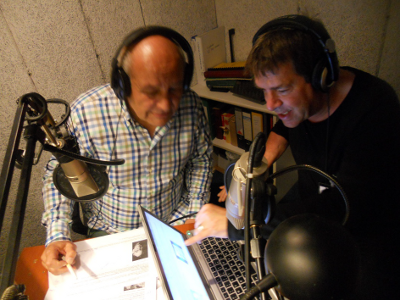
Morgen zijn deze delen live te beluisteren. Dit interview wordt opgenomen en later in het archief geplaatst. Zie ook:
http://www.concertzender.nl/?s=roland+kuit
(De links naar de archiefopnamen van mijn vorige interview zitten hier ook tussen. Kun je dus terug beluisteren)
 
En mis ook deze link niet:
http://www.concertzender.nl/programmagids/?date=2013-10-30&month=0&detail=66787

Deel 3 van Randen van Geluid, waarin u kunt luisteren naar vrijwel het gehele grensverleggende album +/- uit 1997 van Ryoji Ikeda.
In 2006 was Touch labelbaas Mike Harding, tijdens het samenstellen van de Concertzender Touch Nieuwe Muziek Nacht, het over 1 album direct eens, +/- van Ryoji Ikeda was het meest innovatieve werk dat hij ooit had uitgegeven. En nu in 2013, zoveel jaar verder, kan +/- van Ryoji Ikeda opgenomen worden in de lijst van de meest essentiële elektronische muziekwerken; de Canon der Elektronische Muziek.
Vandaar dat we dit meesterwerk vrijwel in zijn geheel uitzenden.

1. +
2. +.
3. +..
4. Headphonics 0/0
5. Headphonics 0/1
6. Headphonics 1/0
7. -
8. -.
9. -..


Samenstelling: Hessel Veldman
 
Kunnen we het a.u.b. bij de pioniers laten? Onderzoekers/componisten en hun werk.

Wat ik graag zou zien is een discussie over welke synthese, productie technieken men gebruikte. En bijvoorbeeld hoe die studio's van toen(en later in de draad, van nu) eruit zien.

Voorbeeld:

Studio für Elektronische Musik, Lawo PTR, WDR, Cologne

Lawo is an international company based in Rastatt, Germany, specializing in the manufacture of digital mixing consoles and other professional audio equipment. It was founded in 1970 by Peter Lawo[citation needed], and is currently run by his son Philipp. The company is notable for supplying the audio mixing equipment for the 2012 London Olympics and Nine Network, and for sports events in Asia, North America and Australia.

The first developments of Peter Lawo were driven by the needs of composers of Electronic Music like Karlheinz Stockhausen. To Stockhausen's specifications Peter Lawo built an apparatus called "module 69 B" which was used to perform Stockhausens composition Mantra. The success of this production led to the founding of the Experimentalstudio of the Heinrich Strobel Foundation of the Südwestfunk in 1971. Together with the first director of this studio, Hans-Peter Haller, Peter Lawo developed the Halaphon. (The name resulted from the names of the developers: HA(ller)-LA(wo)-PHON). This machine became famous when being used in all the later works of composer Luigi Nono.

Later, Peter Lawo developed mixing consoles for Karl Heinz Stockhausen.

The Lawo PTR at Studio für Elektronische Musik, Cologne
His composition Octophonie was produced in the "Studio for Electronic Music" of the German Public Broadcaster "WDR" (Westdeutscher Rundfunk). For the production of this composition, the automatic recall of very fast fader movements was used[4] - which was made possible by Lawo's hybrid mixing console PTR ("Programmierbare Ton Regie" = programmable audio control).(wiki)
 

Attachments

  • STUDIO~1.jpg
    STUDIO~1.jpg
    99,1 KB · Bekeken: 154
Een van de oude studio's waar ik les op kreeg en soms lessen van Jaap Vink overnam. Dan kreeg ik betaald in tapes zonder reel :)
Toen het Instituut voor Sonologie. Nu aan het koninklijk conservatorium in Den Haag.

The Institute for Sonology, Utrecht, the Netherlands

The institute was founded at the University of Utrecht in 1960 under the name STEM ("Studio for Electronic Music") as a successor to the former studio for electronic music at Philips Research Laboratories in Eindhoven. In 1964, Gottfried Michael Koenig became the studio's artistic director. The studio grew under Koenig's leadership, and in 1966 an annual international electronic music course was founded which exists to this day.

In 1967 STEM was renamed as the "Institute of Sonology". International attention increased in 1971 with the purchase of a PDP-15 computer which was used to develop programs for algorithmic composition and digital sound synthesis. During the early years of the institute a series of landmark programs were developed there, including Koenig's Project 1, Project 2, and SSP, Paul Berg's PILE, Werner Kaegi's MIDIM/VOSIM, and Barry Truax's POD.

In 1986, the institute was moved to the Royal Conservatory of The Hague, hosting the International Computer Music Conference there during its inaugural year.

Current research focuses on algorithmic composition, live electronic music, historical reconstructions of electronic and computer music (including György Ligeti's Pièce électronique Nr. 3 and Edgard Varèse's Poème électronique), field recording, sound installations, and sound spatialization. Alongside the annual one-year course, the institute offers Bachelor's and Master's degrees.(Wiki)

Hier de beroemde BEA5-studio
 

Attachments

  • sono.jpg
    sono.jpg
    77,4 KB · Bekeken: 157
  • Studio_BEA_5_(3).jpg
    Studio_BEA_5_(3).jpg
    164,2 KB · Bekeken: 165
De opgenomen klank van de deur uit de uitzending is hier bewerkt.

Studio d'Essai

Later the studio of:
Groupe de Recherche de Musique Concrète

In 1942 the French composer and theoretician Pierre Schaeffer, began his exploration of radiophony when he joined Jacques Copeau and his pupils in the foundation of the Studio d'Essai de la Radiodiffusion Nationale. The studio originally functioned as a center for the Resistance movement in French radio, which in August 1944 was responsible for the first broadcasts in liberated Paris. It was here that Schaeffer began to experiment with creative radiophonic techniques using the sound technologies of the time.

The development of Schaeffer’s practice was informed by encounters with voice actors and microphone usage and radiophonic art played an important part in inspiring and consolidating Schaeffer's conception of sound based composition. Another important influence on Schaeffer’s practice was cinema and the techniques of recording and montage, which were originally associated with cinematographic practice, came to "serve as the substrate of musique concrète." Marc Battier notes that, prior to Schaeffer, Jean Epstein drew attention to the manner in which sound recording revealed what was hidden in the act of basic acoustic listening. Epstein's reference to this "phenomenon of an epiphanic being", which appears through the transduction of sound, proved influential on Schaeffer’s concept of reduced listening. Schaeffer would explicitly cite Jean Epstein with reference to his use of extra-musical sound material. Epstein had already imagined that "through the transposition of natural sounds, it becomes possible to create chords and dissonances, melodies and symphonies of noise, which are a new and specifically cinematographic music".

By 1951 the work of Schaeffer, composer-percussionist Pierre Henry, and sound engineer Jacques Poullin had received official recognition and The Groupe de Recherches de Musique Concrète, Club d 'Essai de la Radiodiffusion-Télévision Française was established at RTF in Paris, the ancestor of the ORTF (Lange 2009, 173). At RTF the GRMC established the first purpose-built electroacoustic music studio. It quickly attracted many who either were or were later to become notable composers, including Olivier Messiaen, Pierre Boulez, Jean Barraqué, Karlheinz Stockhausen, Edgard Varèse, Iannis Xenakis, Michel Philippot, and Arthur Honegger. Compositional output from 1951 to 1953 comprised Étude I (1951) and Étude II (1951) by Boulez, Timbres-durées (1952) by Messiaen, Konkrete Etüde (1952) by Stockhausen, Le microphone bien tempéré (1952) and La voile d’Orphée (1953) by Henry, Étude I (1953) by Philippot, Étude (1953) by Barraqué, the mixed pieces Toute la lyre (1951) and Orphée 53 (1953) by Schaeffer/Henry, and the film music Masquerage (1952) by Schaeffer and Astrologie (1953) by Henry. In 1954 Varèse and Honegger visited to work on the tape parts of Déserts and La rivière endormie (Palombini 1999).

Between 1952 and 1956 Schaeffer's commitments to RTF led him to appoint Philippe Arthuys with responsibility for the GRMC, with Pierre Henry operating as Director of Works. Pierre Henry’s composing talent developed greatly during this period at the GRMC and he worked with experimental filmmakers such as Max de Haas, Jean Gremillon, Enrico Fulchignoni, and Jean Rouch, and with choreographers including Dick Sanders and Maurice Béjart (Gayou 2007, 206). Schaeffer returned to run the group at the end of 1957, and immediately stated his disapproval of the direction the GRMC had taken. A proposal was then made to "renew completely the spirit, the methods and the personnel of the Group, with a view to undertake research and to offer a much needed welcome to young composers"(Wiki).
 

Attachments

  • StudiodEssai-Schaeffe.jpg
    StudiodEssai-Schaeffe.jpg
    16,6 KB · Bekeken: 160
  • studidessay.jpg
    studidessay.jpg
    15,4 KB · Bekeken: 159
Studio di fonologia del 1955 della sede Rai di Milano

The Studio di Fonologia Musicale was founded by Bruno Maderna & Luciano Berio at Milan Radio, in Italy, in 1954.

Designed by Alfredo physical Lietti , was officially opened in June 1955 at the hands of musicians Luciano Berio and Bruno Maderna and remains active until February 28, 1983 , when the technician Marino Sugars retires.
The first composition designed to convince managers Rai was to open the Studio City Portrait of a text by Roberto Leydi , music by Luciano Berio and Bruno Maderna .
The firm was founded primarily for two purposes: the production of experimental electronic music and the realization of comments and soundtracks for radio and television.
Berio drew ideas and information watching America ( intrigued by tape music of Ussachevsky and Luening ) and France ( through his friendship with Schaeffer and the Club d'Essai ) ; Maderna brought the contributions from the study of Cologne through his friendship with Stockhausen and Meyer- Eppler , and summer courses at Darmstadt .

http://youtu.be/BKiddiPyDsE
 

Attachments

  • Studio_di_fonologia_del_1955_della_sede_Rai_di_Milano_-_Museo_degli_strumenti_musicali_del_caste.jpg
    Studio_di_fonologia_del_1955_della_sede_Rai_di_Milano_-_Museo_degli_strumenti_musicali_del_caste.jpg
    61,1 KB · Bekeken: 151
Bell Laboratories
(also known as Bell Labs and formerly known as AT&T Bell Laboratories and Bell Telephone Laboratories) is the research and development subsidiary of the French-owned Alcatel-Lucent in Berkeley Heights, New Jersey, United States. It previously was a division of the American Telephone & Telegraph Company (AT&T Corporation), half-owned through its Western Electric manufacturing subsidiary.

Bell Laboratories operates its headquarters at Murray Hill, New Jersey, and has research and development facilities throughout the world. Researchers working at Bell Labs are credited with the development of radio astronomy, the transistor, the laser, the charge-coupled device (CCD), information theory, the UNIX operating system, the C programming language, S programming language and the C++ programming language. Seven Nobel Prizes have been awarded for work completed at Bell Laboratories.(Wiki)
 

Attachments

  • ff-grooveAnalog.jpg
    ff-grooveAnalog.jpg
    71,8 KB · Bekeken: 152
  • SIGSALY.jpg
    SIGSALY.jpg
    349,4 KB · Bekeken: 152
  • Mathews84Violin.jpg
    Mathews84Violin.jpg
    27,5 KB · Bekeken: 157
Op de foto van Fracis Bayle verder terug in deze draad zag je een ronde speaker box staan. Die is uit de studio van:

Groupe de Recherches Musicales (GRM)

Following the emergence of differences within the GRMC Pierre Henry, Philippe Arthuys, and several of their colleagues, resigned in April 1958. Schaeffer created a new collective, called Groupe de Recherches Musicales (GRM) and set about recruiting new members including Luc Ferrari, François-Bernard Mâche, Iannis Xenakis, Bernard Parmegiani, and Mireille Chamass-Kyrou. Later arrivals included Ivo Malec, Philippe Carson, Romuald Vandelle, Edgardo Canton and François Bayle (Gayou 2007, 207).

GRM was one of several theoretical and experimental groups working under the umbrella of the Schaeffer-led Service de la Recherche at ORTF (1960–74). Together with the GRM, three other groups existed: the Groupe de Recherches Image GRI, the Groupe de Recherches Technologiques GRT and the Groupe de Recherches Langage which became the Groupe d’Etudes Critiques (Gayou 2007, 207). Communication was the one theme that unified the various groups, all of which were devoted to production and creation. In terms of the question "who says what to whom?" Schaeffer added "how?", thereby creating a platform for research into audiovisual communication and mass media, audible phenomena and music in general (including non-Western musics) (Beatriz Ferreyra, new preface to Schaeffer and Reibel 1967, reedition of 1998, 9). At the GRM the theoretical teaching remained based on practice and could be summed up in the catch phrase ‘do and listen’ (Gayou 2007, 207).

Schaeffer kept up a practice established with the GRMC of delegating the functions (though not the title) of Group Director to colleagues. Since 1961 GRM has had six Group Directors: Michel Philippot (1960–61), Luc Ferrari (1962–63), Bernard Baschet and François Vercken (1964–66). From the beginning of 1966, François Bayle took over the direction for the duration of thirty-one years, to 1997. He was then replaced by Daniel Teruggi(Wiki)
 

Attachments

  • GRM museum.jpg
    GRM museum.jpg
    231,6 KB · Bekeken: 152
  • grm1.jpg
    grm1.jpg
    13,3 KB · Bekeken: 149
Laatst gewijzigd:
IMEB (Institut International de Musique Electroacoustique de Bourges)

Founded in 1970 by Françoise Barrière and Christian Clozier, the Institut international de musique électroacoustique de Bourges (née Groupe de musique électroacoustique de Bourges) has played host to a diverse array of electronic composers, publishing their works largely via the Le Chant du Monde label's Chrysopée Electronique series, organizing concert events, and promoting the ongoing sound research that makes electronic music possible. For the most part, the many electronic music studio camps are difficult to truly characterize, with IMEB no exception. Given the many nations represented among its roster and their varied activities, the closest I can come to an IMEB worldview would be to welcome with open arms all practices electronic.

And a new build instruments for kids and MAX/MSP:
'Le Cybersongosse'
 

Attachments

  • bouges.jpg
    bouges.jpg
    180,5 KB · Bekeken: 154
  • Le Cybersongosse'.jpg
    Le Cybersongosse'.jpg
    31,4 KB · Bekeken: 144
Thanks Chielos!
Het is door drukte.
Concert deze maand en daarvoor moet nog veel gebeuren.
Concert op de radio en daarvoor moet ook nog veel gebeuren.
En daarna weer werk in Zweden tot midden Jan 2014

Ik wilde het nog uitbreiden naar 'muziek notatie' uit de begintijd en later.
Mischien later dus.
 

Attachments

  • image0-11.jpg
    image0-11.jpg
    78,4 KB · Bekeken: 148
Back
Top