DE GEKSTE de ONBEKENDSTE enz.

Origineel geplaatst door astronaut
Ja, ik weet nog wel toen die Yamaha's op de markt werden gezet. Althans de hele promo campagne van tevoren. Zou de nieuwe synthesizer revolutie zijn. Nooit echt iets van gehoord.

Het is maar hoe je het bekijkt. In principe zijn deze synths de grootmoeders van alles VA. De VP en VL van Yamaha waren de eerste synths waarbij het geluid gemodelleerd werd. Dus toch een kleine revolutie?:walker:
 
Re: Je hebt gelijk!!

Re: Je hebt gelijk!!

Origineel geplaatst door astronaut
Deze thread was een beetje in slaap gesukkeld en dat verdiend hij niet!!!

Welke synth mag dat zijn astronaut??? :D
 
Oberheim digital sequencer:
 

Attachments

  • oberheimdigital_sequencer.jpg
    oberheimdigital_sequencer.jpg
    15,8 KB · Bekeken: 125
Strider DCSII
dcs2.gif


Octave PlateauCat SRM
srm.jpg

Octave Plateau Catstick ( e hehehe )
CATSTICK.gif

Gleeman Pentaphonic Clear
pentclear.jpg


The Gleeman Pentaphonic Clear is a stylish "wearable" polyphonic synthesizer. Each
voice has its own VCF and two ADSRs, 2 oscillators per voice (each with 8 waveshapes),
and more. Features include a 600 note sequencer with separate gain, chromatic transpose
function for both sequencer and keyboard, separate power supply for reduced weight and
increased mobility (20 foot extension cable included along with leather shoulder strap), clear
enclosure and controls, and much more. ( jaja, zijn maar iets van 20 van gemaakt )

Een GDS ( General Development System ) door Crumar.
GDS.gif

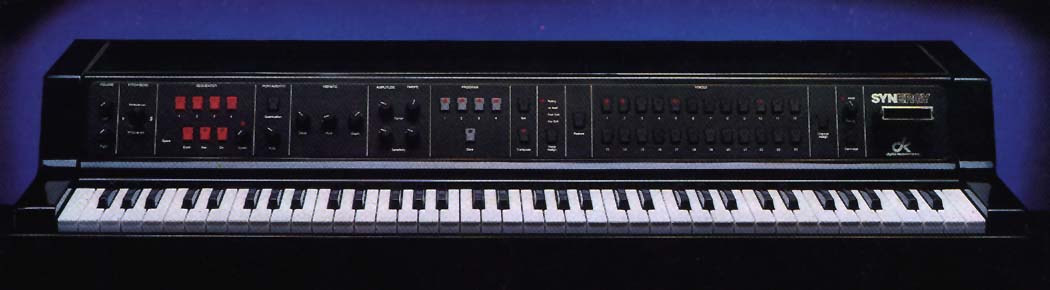
Een synergy door Digital Keyboards Inc.
synergy01.jpg


"To avoid any confusion, Synergy cartridges stored patch data, not waveforms.

"Wendy continues: ...'The Synergy's oscillator table was 12-bit. Its frequency tables were specified to be 16-bit, and then they were interpolated to be 20-bit, which is how they're able to be used on the microtonality tables. So they're really a good bit better - and I don't mean the pun - than the spec might look. And if you're putting together big additive voices, 12-bit isn't a big limitation, because you'd have to crank down the level of 16-bit oscillators so that the total didn't exceed 16 total [at the output DAC] in the end anyway.'"

Last but not least...

PETERSON BOTTLE ORGAN
bboang.jpg
 
Re: Re: Je hebt gelijk!!

Re: Re: Je hebt gelijk!!

Origineel geplaatst door Mennomoog
Welke synth mag dat zijn astronaut??? :D

Een of andere homemade wav synth van ...... .......
:)
 
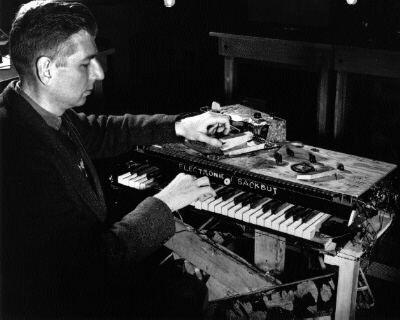
The Electronic Sackbut

The Electronic Sackbut

sb5.jpg


...is de aller-eerste Voltage Controlled Synthesizer. Gebouwd rond 1945 door ene Hugh LeCaine.

In 1945, when the first Sackbut was built inside a desk, Le Caine visualized an instrument in which the operator would control three aspects of sound through operations on the keyboard in three co-ordinates of space: vertical pressure was to correspond to volume; lateral pressure to pitch change; and pressure away from the performer to timbre.

The control devices were force sensitive. They would alter the sound in response to changes in pressure, something the operator could feel without carefully watching the controls. The timbre controls, however, were soon considerably expanded and could no longer be operated by a single device.

Two innovative techniques stand out in the design of the Sackbut: the use of adjustable wave forms as timbres and the development of voltage control. It is in this regard that the Sackbut is recognized to be the forerunner of the synthesizers of the 1970's.

Hier staat nog een leuke pagina over dit interessante apparaat.

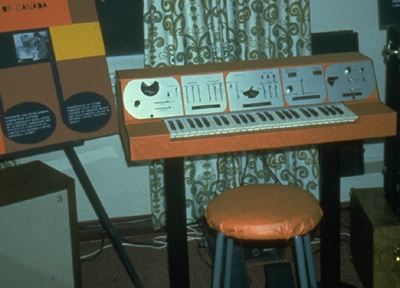
In 1971 heeft men nog geprobeerd een moderne versie van de Electronic Sackbut te bouwen.
Dit was echter geen groot succes, en het is dan ook bij een prototype gebleven:
sbcom.jpg
 
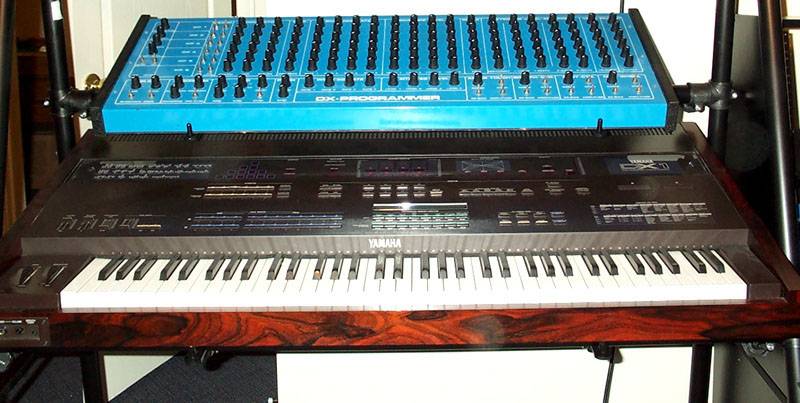
Best dubbel deze...een DX1, de makkelijkst te programeren dx synth, en dan toch de programmer erbij :D

dx1gal5.jpg
 
Laatst gewijzigd:
:{
 
What the hell is this?

What the hell is this?

jhammond.jpg


Een synthesizer van Hammond? Uit Japan?
Nooit van gehoord! Wie wel?
 
Ja, de Hammond is hier al eens eerder voorbij gekomen. Leuke nieuwe plaatjes overigens. Hier nog wat speelgoed..
 

Attachments

  • keygizmotron.jpg
    keygizmotron.jpg
    25,6 KB · Bekeken: 132
Re: What the hell is this?

Re: What the hell is this?

Origineel geplaatst door Hanz
jhammond.jpg


Een synthesizer van Hammond? Uit Japan?
Nooit van gehoord! Wie wel?

Je kunt hem terugvinden in Peter Forrest's A-Z (helaas geen foto).
Een bak uit de 70'er jaren, in de westerse wereld op de markt gebracht als SY-100.
Ontwikkeld in samenwerking met Ace, die hetzelfde apparaat heeft uitgebracht onder
hun eigen naam.
 
Re: Re: What the hell is this?

Re: Re: What the hell is this?

Origineel geplaatst door senso
Je kunt hem terugvinden in Peter Forrest's A-Z (helaas geen foto).
Een bak uit de 70'er jaren, in de westerse wereld op de markt gebracht als SY-100.
Ontwikkeld in samenwerking met Ace, die hetzelfde apparaat heeft uitgebracht onder
hun eigen naam.

Ah, uit mijn lijfboek... :halleluja
Ik ga het eens opzoeken! Mijn dank.
 
Uit de door Siemens in 1959 gebouwde synthesizer-studio:

siemens_vocoder.gif

Siemens Vocoder (met buizen!)

siemens_studio.gif

Programming with the 'Semi Automatic Hole-strip Punching Machine'

Autumn 1955.
-The directors of Siemens decide, inspired by the German composer Carl Orff, to create a soundtrack of electronic music for the documentary movie about the Siemens Company- "Impulse of our Time". To create this soundtrack Siemens began the devlopment of the equipment and apparatus necessary for the creation and manipulation of electronic sounds.

October 1956
-The work group of the Siemens Central Laboratory starts the construction of the equipment in the electro acoustic laboratory in Gauting, near Munich. The apparatus consisted of; a vocoder (already installed in the laboratory for the field of language & music modulation), a specially designed punch tape-strip controller that controlls the pitch, duration and colour of a bank of oscillators, A punch tape reader, a sawtooth generator, reverb plate and a mixing desk

Spring 1959
-Making of the music for the movie. Internal showing of the film. First showing of the film with live punch-tape contolled sequenced electronic music.

February 1960
-Visits ito the laboratory by Pierre Boulez, Herbert Brün, Werner Egk, Karl Amadeus Hartmann, Ludwig Heck, Ernst Krenek, Henri Pousseur, Fred K.Prieberg, Hermann Scherchen with his disciples.
-Due to interest caused by the showing of the Siemens documentary and from other composers it was decided on the 17th july 1959, to install a permanent studio for electronic music.

October 1960
-The electronic music studio moves into a two room area in the Siemens building at the Oskar-von-Müller-Ring, Munich.
-Installation of a picture scanner ("bildabtaster") for sound generation and volume modulation.
-Start of work in the field of applied music, electronic sound arrangement, electronic sounds for film, television, radio, theatre.
-Visits at the studio by Werner Meyer-Eppler, Gottfried Michael König, Abraham Moles.

July 1961
-Installation of the studio in six rooms in the Siemens building at Oskar-von-Müller-Ring.
-Start of permanent development work for the studio, amongst other things development of technique of sound synthesis, e.g. paper strip sequencing of 20 sine-generators with special installations.
-Possibility of two work shifts at the studio.
-Visits by Niccolo Castiglioni, Mauricio Kagel, György Ligeti, Andrzej Markowski, Jaques Wildberger, Yannis Xénakis.

July 1961 onwards
-1961 saw a concentration on individual composition and sound experimentation.Contacts were made with Pierre Boulez, Niccolo Castiglioni, Maurizio Kagel, Bruno Maderna, Henri Pousseur, Karlheinz Stockhausen and Yannis Xenakis who contributed to a series of record releases in 1961.
-"Introduction to Electronic Music" by Henri Pousseur released on vinyl record with a book.
-Visits by Boris Blacher, Gottfried von Einem, Franco Evangelisti, Jacques Guyonnet, Rafael Kubelik, Otto Luening, Myron Schaeffer, Karlheinz Stockhausen, Vladimir Ussachevsky.
Josef Anton Riedl.

Meer info op deze link.
 
Vako Orchestron

Vako Orchestron

vako1.jpg


...doet de Yamaha FX-1 en GX-1 verbleken!

vako2.jpg
 
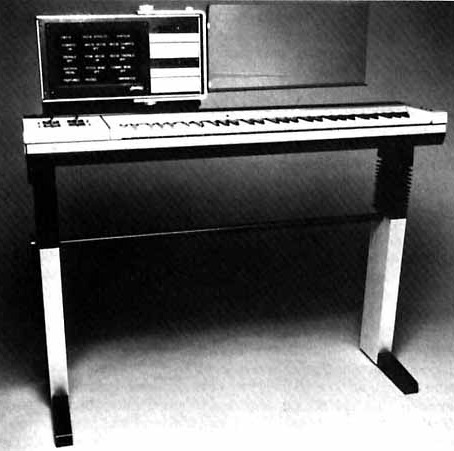
ASI Synthia

ASI Synthia

Deze is mooi!

synthia.jpg


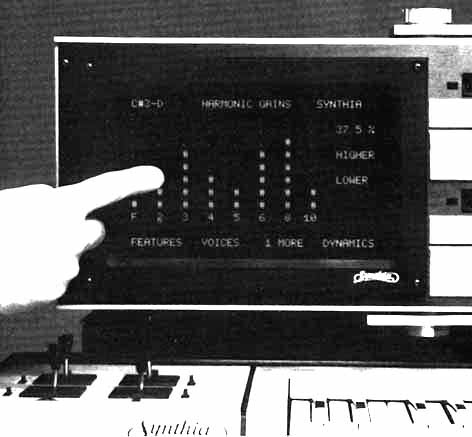
SYNTHIA / pol syn kmi cms 20000 (1982)
Computergesteuerter Polysynthesizer. Der SYNTHIA verfügt über vier Joysticks und einem berührungsempfindlichen Plasma-Bildschirm ähnlich dem FAIRLIGHT oder WERSI PEGASUS. Das Instrument besitzt neben umfangreichen Eingriffsmöglichkeiten eine 61er-Tastatur und links daneben vier (!!) Joysticks für Modulationseffekte und ähnlichem. Keyboard und Speichereinheit sind getrennt voneinander. Unter anderem kann dieses achtstimmige System Additive Synthese bis zum achten Oberton generieren, ist zur Interpolation zwischen zwei Klängen in der Lage (neudeutsch als "Morphing" bekannt). Der SYNTHIA ist mehrfach multitimbral und grundsätzlich erweiterbar. Meines Wissens existiert nur ein Prototyp oder maximal bis zu 10 Exemplare.
 
ziet er mooi uit... maar ja 't is vooral de klank die telt hé - en gezien dit een eerder onbekende synth is vraag ik me af of die klank wel goed was...
 
Origineel geplaatst door THM
ziet er mooi uit... maar ja 't is vooral de klank die telt hé - en gezien dit een eerder onbekende synth is vraag ik me af of die klank wel goed was...

Dat zegt niks. Waarschijnlijk te exclusief en te duur. Ook niet elke violist heeft een strat.:eureka:

Hanz, wat een top-plaatjes trouwens. Waar haal je het vandaan????

En die synth (ASI Synthia). Wie heeft er een MP3-tje / Wav-je.
 
Ook wel waar... :biertje:
 
Origineel geplaatst door astronaut
Hanz, wat een top-plaatjes trouwens. Waar haal je het vandaan????

Die laatste 3 (Sonic V, Orchestron en Synthia) van een link met een enorme verzameling leuks die iemand had geplaatst in de Grote Synth Folder thread. (Samen met deze thread en de Synth Nerd Clips thread waarschijnlijk m'n favoriete plek op dit forum! ;))

De bijbehorende informatie komt van Synrise, ook al zo'n standaard reference site.

Trouwens, nog meer Synthia lekkers van Synthmuseum:

asisynthia01a.jpg

asisynthia01b.jpg


"The Synthia was yet another bid for the obviously limited high-end market for computerized all-in-one-box ultra-keyboards. Although the Synthia's projected price was ... a mere $20,000 - few musicians seem to have had a close encounter with a working model. The most, um, interesting aspect of the Synthia was its touch-responsive plasma screen, a computer display-cum-data-entry device that followed the user's finger as he or she sketched around bar graphs - the ultimate in intuitive user interfaces.... Among the touch-responsive displays were editing screens for harmonic content (up to seven partials), envelope parameters, keyboard setups, controller assignments, and, once again, an implementation of the timbre window concept (called 'time slices').

Quote uit Mark Vail's Vintage Synthesizers: "The Synthia's controller section was also particularly impressive. Four panel positions were available for sliders, joysticks, and touch plates, which could modulate a number of parameters including the pitches of individual harmonics. There were also three expression pedals, three switch pedals, and of course a velocity- and aftertouch-sensitive keyboard. The accompanying computer, or 'control unit,' was housed in a separate box, and could accommodate incoming data from four keyboards."
 
Back
Top