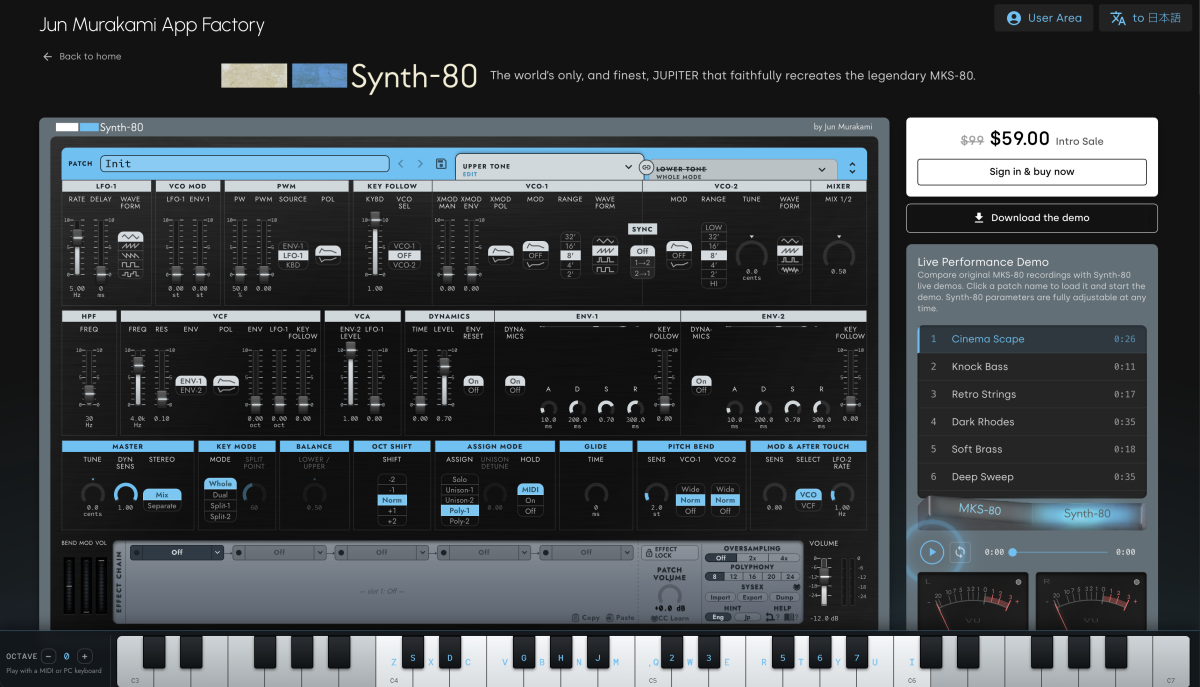
"The world’s only, and finest, JUPITER that faithfully recreates the legendary MKS-80."
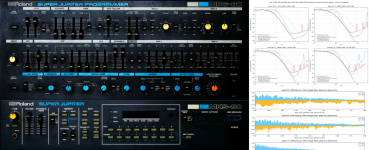
Deze Japanse meneer heeft de MKS-80 Rev4 helemaal geanalyseerd en er een toffe emulatie van gemaakt:
Synth-80 | Jun Murakami App Factory
Authentic sound, meticulously analyzed
The Roland MKS-80 SUPER JUPITER is a legendary synthesizer produced only for a short period beginning in 1984. Often overshadowed by popular keyboards such as the JUPITER-8, this 8-voice polyphonic analog synthesizer is defined not only by its refined sound but also by a remarkable trait: almost every one of its parameters can be controlled over MIDI. For a fully analog synthesizer of its era this was extraordinarily rare, and it makes the MKS-80 an ideal subject for software-synthesizer research — in other words, it is easy to build measurement programs that retrigger notes again and again while automatically sweeping the parameters, capturing detailed analyses. For this project I wrote more than 100 dedicated automated measurement programs covering every circuit and parameter of the MKS-80. This long-term, detailed analysis of the MKS-80 (Rev.4) was carried out in parallel with the software programming itself, and I pushed the audio DSP tuning to the very limit, relying on the ears I have cultivated over many years as a composer and music producer. As a result, when you load exactly the same patch on both and play them side by side, for many patches it is virtually impossible to tell which is the software and which is the hardware. From the delicate characteristics of the filters to the noise oscillators with subtle nuances derived from IC chips, the sound texture, recreated with meticulous attention to every detail, elevates the level of hardware emulation to a new height.
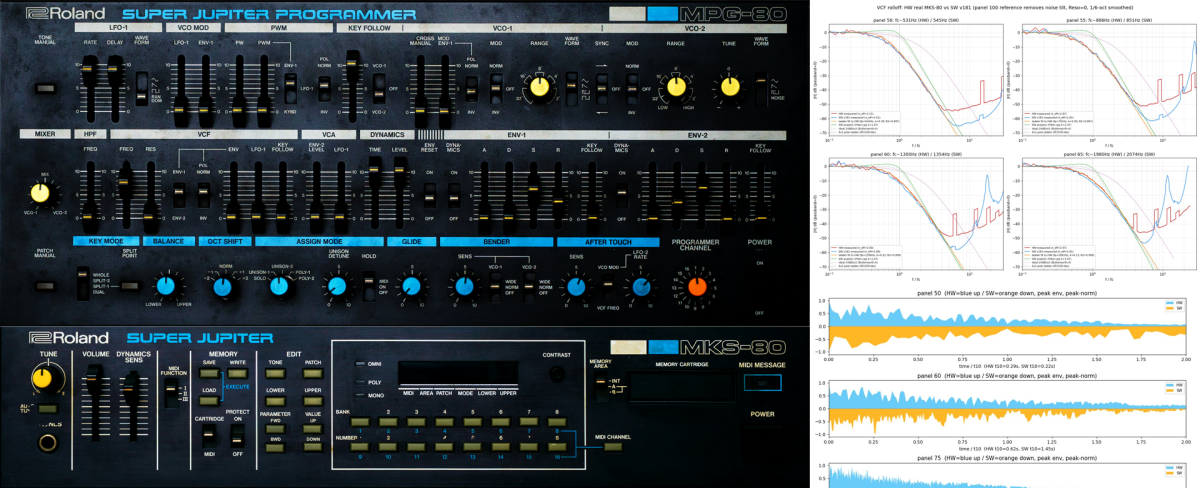
Deze Japanse meneer heeft de MKS-80 Rev4 helemaal geanalyseerd en er een toffe emulatie van gemaakt:
Synth-80 | Jun Murakami App Factory
Authentic sound, meticulously analyzed
The Roland MKS-80 SUPER JUPITER is a legendary synthesizer produced only for a short period beginning in 1984. Often overshadowed by popular keyboards such as the JUPITER-8, this 8-voice polyphonic analog synthesizer is defined not only by its refined sound but also by a remarkable trait: almost every one of its parameters can be controlled over MIDI. For a fully analog synthesizer of its era this was extraordinarily rare, and it makes the MKS-80 an ideal subject for software-synthesizer research — in other words, it is easy to build measurement programs that retrigger notes again and again while automatically sweeping the parameters, capturing detailed analyses. For this project I wrote more than 100 dedicated automated measurement programs covering every circuit and parameter of the MKS-80. This long-term, detailed analysis of the MKS-80 (Rev.4) was carried out in parallel with the software programming itself, and I pushed the audio DSP tuning to the very limit, relying on the ears I have cultivated over many years as a composer and music producer. As a result, when you load exactly the same patch on both and play them side by side, for many patches it is virtually impossible to tell which is the software and which is the hardware. From the delicate characteristics of the filters to the noise oscillators with subtle nuances derived from IC chips, the sound texture, recreated with meticulous attention to every detail, elevates the level of hardware emulation to a new height.