Kyma X - Pacarana

Bach met een extra formant:

3%20Rnd%20Formant%20Bach.jpg


http://soundcloud.com/roland-kuit/three-rnd-formant-bach
 
Werken met formanten:
TwoFormantVoiceElement
(...)

Een klassieke functie! en fundamenteel! Ik heb 'm nagebouwd met WW:
https://www.synthforum.nl/forums/showpost.php?p=1772792&postcount=618

In WaveWizard kun je weliswaar gemakkelijk op een toongenerator een tremolo en vibrato zetten, maar dit Kyma-voorbeeld laat zien wat voor kracht er schuilt in de interface, met die muis-beweeglijke parameter als de toonhoogte van de excitator. Daar ben ik in WW wel jaloers op! :okdan:
 
Zoals je hoort, krijg je een AA-klinker (zoals in "maan") als Reso 1 op 1000 Hz staat. Maak je daar bijv. 800 Hz van, dan hoor je meer een A (zoals in "man"). Die 2450 Hz geeft een formantje dat min of meer samenvloeit met die van 2700 Hz; dat schiet dus niet echt op. Maar je kunt dat natuurlijk allemaal zelf controleren en ook eigen klinkers maken.
Ik zal binnenkort een methode beschrijven waarmee je formanten van bijv. je eigen stem kunt afleiden en uitdrukken in resonantiefrequenties, bandbreedtes en gains. (Dat kan met WW in principe ook geheel geautomatiseerd, maar in de huidige versie "slaapt" die instructie nog.)

Hier is een aardig artikel over formanten:
http://www.feilding.net/sfuad/musi3012-01/html/lectures/017_instruments_IV.htm

vocal_formant_freqs.jpg
 
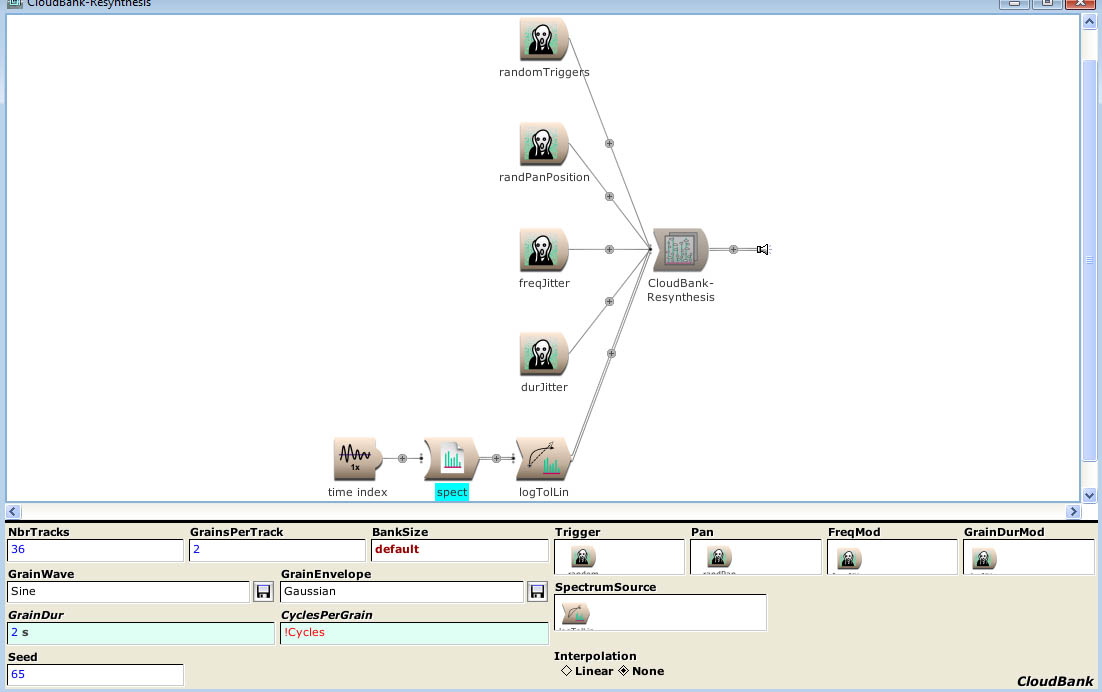
Spraak laten verwateren d.m.v. een CloudBank.

CloudBank

Grain clouds whose center frequencies and amplitudes are supplied by a SpectrumSource and whose frequency deviation, grain duration deviation, pan, and likelihood of triggering are supplied by input Sounds.

NbrTracks
This is the number of tracks from the SpectumSource that will be used by this CloudBank.

GrainsPerTrack
The number of grains dedicated to synthesizing each track of the SpectrumSource.

BankSize
The number of grains to be scheduled on each processor. It's best to leave this at "default" unless you are trying to optimize it by scheduling more or fewer grains per processor.

GrainWave
This is the waveform inside each grain. This file should have exactly 4096 samples.

GrainEnvelope
This is the envelope shape on each grain. This file should have exactly 4096 samples..

Cloudbank%20Resynthesis.jpg


http://soundcloud.com/roland-kuit/is-how-much-we-do-not-know
 
Een kleine zijsprong n.a.v. deze draad:
https://www.synthforum.nl/forums/showthread.php?p=1773568#post1773568

Analoog versus digitaal.
Waar analoog een wat warmer karakter heeft door verloop. Dit kan overigens perfect worden nagebootst. Ook de aangename analoge vervorming kan worden gemeten en daarna digitaal in elkaar gezet worden.

Het volgende voorbeeld laat een andere granulaire beweging horen.
In het vorgige voorbeeld de spectrum CloudBank. Nu een SampleCloud module.
We kunnen d.m.v. de Index parameter door het gesampelde zin scrollen. Maar ook granular( hier random) vooruit en teruggrijpen.

SampleCloud.jpg


http://soundcloud.com/roland-kuit/samplecloud
 
SynthesicSpectrum als glottal pulse voor de FormantBank-Element:

FormantBank-Element

Synthesizes a filtered pulse train where the filter is based on the shape of the FormantImpulse and on the formant frequencies, amplitudes, and bandwidths that you supply in the Spectrum parameter (which is usually a SyntheticSpectrumFromArray Sound).

FormantBank-Element.jpg


http://soundcloud.com/roland-kuit/formantbank-element
 
Filters en voice.
n.a.v. deze draad:
https://www.synthforum.nl/forums/showthread.php?p=1774106#post1774106

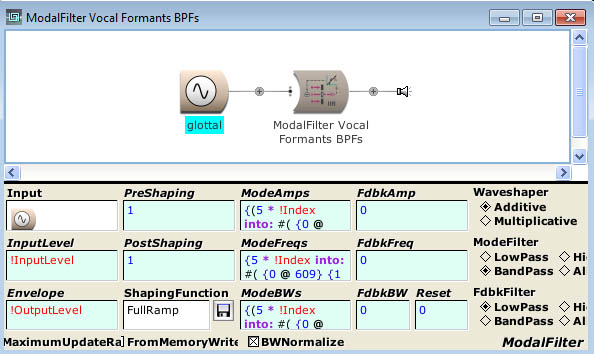
ModalFilter
This Sound is a collection of modes with optional filtering and/or distortion in the feedback loop. You can use ModalFilter to model objects like rooms, strings, air columns, membranes, pieces of metal or other objects for which you can obtain data on the mode frequencies, amplitudes and bandwidths.
Internally the signal flow is:
Additive:
[((Fdbk * FdbkAmp) * PreShaping -> Waveshaper) * PostShaping + (Input * InputLevel)] --> modes
Multiplicative:
sum = (Fdbk * FdbkAmp) + (Input * InputLevel)
[(sum * PreShaping -> Waveshaper) * PostShaping * sum] --> modes
(modes * Envelope) --> output
modes --> FdbkFilter --> Fdbk
You can use subparts of this algorithm, for example, the modes without feedback or the feedback without filtering or distortion, or the feedback without the mode filters. (See the individual parameter help messages for the values that turn off various sections).

Modal%20Filter%20Vocal%20Formants.jpg


http://soundcloud.com/roland-kuit/modalfilter-vocal-formants
 
Speaking Guitar
(kan beter maar had geen ander audio materiaal zo snel)

FilterBank
This is a bank of bandpass filters whose center frequencies and amplitudes are controlled by the frequency and amplitude envelopes of the Spectrum input.
NbrFilters
This is the number of filters in the bank. The number should be less than or equal to the number of partials in the Spectrum input. The more filters you ask for, the more computation is required, so experiment with finding the minimum number of filters that will still give you the desired result.
BankSize
This is the number of filters that Kyma will schedule on each processor. Leave this set to default unless you are running out of realtime; in that case, try adding or subtracting one or two filters from the default BankSize, e.g.
default - 2
and using the DSP Status view to see if that results in a more even distribution of computation across your multiple processors.


Speaking%20Guitar.jpg


http://soundcloud.com/roland-kuit/speaking-guitar
 
Deze post n.a.v. De miljoen-signalen mixer hier:
https://www.synthforum.nl/forums/showthread.php?t=182807

Ring Modulatie:

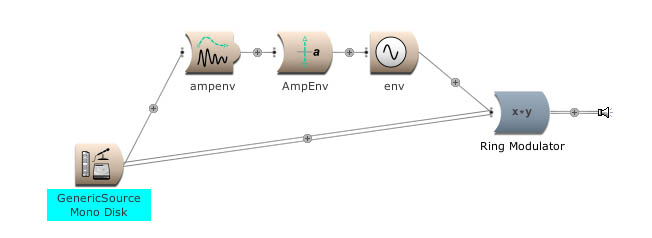
Product

Outputs the product of its Inputs. If there are two, audio frequency inputs, this does ring modulation. If one of the Inputs changes at sub-audio frequencies and the other is at audio frequencies, the effect will be like applying an amplitude envelope to the Input that is at audio frequencies.

RM%201.jpg


Stem en sinus product:

http://soundcloud.com/roland-kuit/ring-modulation-1

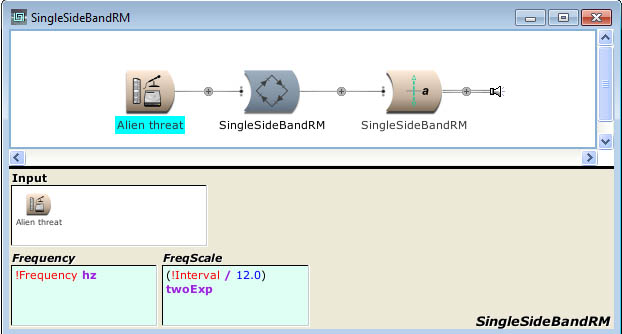
SingleSideBandRM

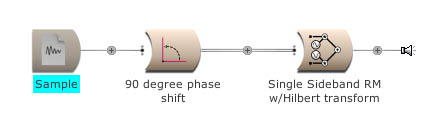
Does nonharmonic frequency scaling of the input. Takes the input and does a 90 degree phase shift between the left and right channels at the frequency specified in the Frequency parameter field. Multiplies this by a QuadratureOscillator with sine in the left and cosine in the right. The resulting ring modulation gives you sum and difference frequencies but, because they are 90 degrees out of phase, the difference frequency is mostly cancelled out, leaving you with single side band modulation. Expand to see how this is put together.

SingleSideBandRM%201.jpg


SingleSideBandRM

Does nonharmonic frequency scaling of the input. Takes the input and does a 90 degree phase shift between the left and right channels at the frequency specified in the Frequency parameter field. Multiplies this by a QuadratureOscillator with sine in the left and cosine in the right. The resulting ring modulation gives you sum and difference frequencies but, because they are 90 degrees out of phase, the difference frequency is mostly cancelled out, leaving you with single side band modulation. Expand to see how this is put together.

http://soundcloud.com/roland-kuit/singlesidebandrm-1
 
Hilbert transform en Ring Modulatie:

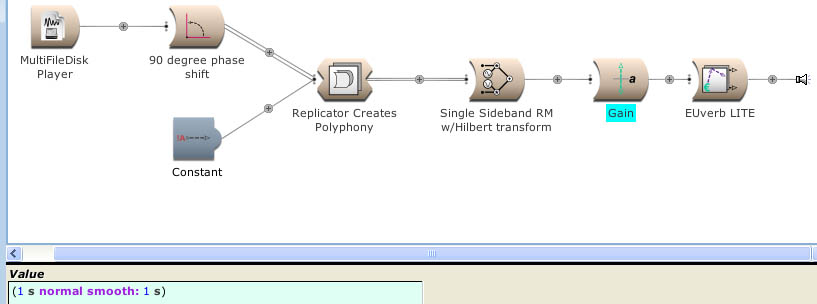
Single%20Sideband%20RM%20w-Hilbert%20transform.jpg

HilbertTransform

The output of this module can be fed directly into a QuadOscillator for single-sideband ring modulation. The left channel is the Input phase-shifted by 90 degrees. The right channel is the Input. Delay through this module is ((numberTaps - 1)/ 2 + 1) samples. The larger the number of taps, the higher the quality of the phase shift (but the more processing time required and the longer the delay time through the module).

Strijkers en sinus:

http://soundcloud.com/roland-kuit/strings-ssb-whilbert-transform

Nu had Rutger het over een miljoen signalen om te mixen. Hij heeft gelijk, de computer kan dat in een oogwenk.
In het volgende gebruik ik een dublicator module. Ik kan zelf de hoeveelheid dupliceringen invoeren.

Strings%20SSB%20Rand%20Duplicated.jpg


http://soundcloud.com/roland-kuit/strings-ssb-rand-duplicated-with-reverb
 
Roland, ben je in Kyma ook functies tegengekomen waarmee je blinde deconvolutie kunt doen?
 
Roland, ben je in Kyma ook functies tegengekomen waarmee je blinde deconvolutie kunt doen?

Rutger, bedoel je b.v. galm weghalen zoals in audio restauration?
Dit zit er niet 'standaard' in maar ik denk dat het wel kan.
Er zijn erg veel mogelijkheden om de responce live te beïnvloeden.
 
Back
Top