tjebbestorm
Storm op de maan
over de: GDS
Co-developed by and marketed in the US
by Digital Keyboards Inc., the
CRUMAR General Development
System (GDS) offers both a complete
sound synthesis laboratory and a high
quality performance instrument in a
single unit. Advanced logic design
technology has been fused with
state-of-the-art digital sound synthesis
techniques to create a new dimension in
real-time sound production. Intended as a
tool for performing and studio musicians,
composers, researchers and educators, the
GDS emphasizes accuracy, flexibility and
convenience. Precise digital computation
of waveforms, envelopes and harmonics,
coupled with studio-quality audio output,
provides a degree of control not
achievable with analog technologies. A
wide range of musically meaningful
parameters enables the immediate
realization of a tremendous variety of
sounds. These parameters, carefully
arranged in logical groups, can be
instantly allocated to sliders, rotary pots
and switches, for fingertip control. The
GDS is a completely digital synthesizer.
Consequently, it is free from the
problems of traditional analog units.
Since the GDS is under the control of a
supplied computer program, patches can
be installed and changed quickly. Temperature sensitivity is also no longer a problem;
the GDS does not have to be constantly retuned as it warms up.
Most important, once the setting of a control has been established,
it can be remembered exactly.
Thus, a sound "found" can be saved and recalled for future use. The GDS uses a
Z-80 microcomputer to supply data to special high-speed digital circuits that simulate the activity of 32
high-quality oscillators.
The oscillator output is fed to a 16-bit, digital-to-analog converter to insure clean,
recording-quality sound. A pair of double-density flexible disk drives provides fast storage and retrieval of
voices, filters, recorded sequences and performance configurations.
The unit is operated via a control panel
with 65 input devices and a 61-note, velocity sensitive keyboard.
A CRT terminal is included for instant display of parameters and key/pot settings.
The GDS software is divided into two complementary programs.
The Voicing program facilitates the interactive design of sounds and timbres with immediate audio feedback.
A voice may utilize up to 16 oscillators, each with its own basic waveform and independent frequency and
amplitude envelopes.
These oscillators may be patched into various useful configurations. the keyboard.
Chords are split up and presented one note at a time so that,for example, a chord can be changed from major
to minor.
A transposition mode allows an entire playing sequence to be transposed up or down as much as an
octave by pressing a key in the lower two octaves of the keyboard.
The current transposition will be
"remembered" by the voices in the sequencer, even after the keyboard is returned to normal use. A "rhythm"
control converts arbitrary timings to evenly spaced intervals, detecting the presence of chords and maintaining
their integrity.
In conjunction with the speed control, this feature provides a precise clock for recording "click
tracks," et..
Co-developed by and marketed in the US
by Digital Keyboards Inc., the
CRUMAR General Development
System (GDS) offers both a complete
sound synthesis laboratory and a high
quality performance instrument in a
single unit. Advanced logic design
technology has been fused with
state-of-the-art digital sound synthesis
techniques to create a new dimension in
real-time sound production. Intended as a
tool for performing and studio musicians,
composers, researchers and educators, the
GDS emphasizes accuracy, flexibility and
convenience. Precise digital computation
of waveforms, envelopes and harmonics,
coupled with studio-quality audio output,
provides a degree of control not
achievable with analog technologies. A
wide range of musically meaningful
parameters enables the immediate
realization of a tremendous variety of
sounds. These parameters, carefully
arranged in logical groups, can be
instantly allocated to sliders, rotary pots
and switches, for fingertip control. The
GDS is a completely digital synthesizer.
Consequently, it is free from the
problems of traditional analog units.
Since the GDS is under the control of a
supplied computer program, patches can
be installed and changed quickly. Temperature sensitivity is also no longer a problem;
the GDS does not have to be constantly retuned as it warms up.
Most important, once the setting of a control has been established,
it can be remembered exactly.
Thus, a sound "found" can be saved and recalled for future use. The GDS uses a
Z-80 microcomputer to supply data to special high-speed digital circuits that simulate the activity of 32
high-quality oscillators.
The oscillator output is fed to a 16-bit, digital-to-analog converter to insure clean,
recording-quality sound. A pair of double-density flexible disk drives provides fast storage and retrieval of
voices, filters, recorded sequences and performance configurations.
The unit is operated via a control panel
with 65 input devices and a 61-note, velocity sensitive keyboard.
A CRT terminal is included for instant display of parameters and key/pot settings.
The GDS software is divided into two complementary programs.
The Voicing program facilitates the interactive design of sounds and timbres with immediate audio feedback.
A voice may utilize up to 16 oscillators, each with its own basic waveform and independent frequency and
amplitude envelopes.
These oscillators may be patched into various useful configurations. the keyboard.
Chords are split up and presented one note at a time so that,for example, a chord can be changed from major
to minor.
A transposition mode allows an entire playing sequence to be transposed up or down as much as an
octave by pressing a key in the lower two octaves of the keyboard.
The current transposition will be
"remembered" by the voices in the sequencer, even after the keyboard is returned to normal use. A "rhythm"
control converts arbitrary timings to evenly spaced intervals, detecting the presence of chords and maintaining
their integrity.
In conjunction with the speed control, this feature provides a precise clock for recording "click
tracks," et..


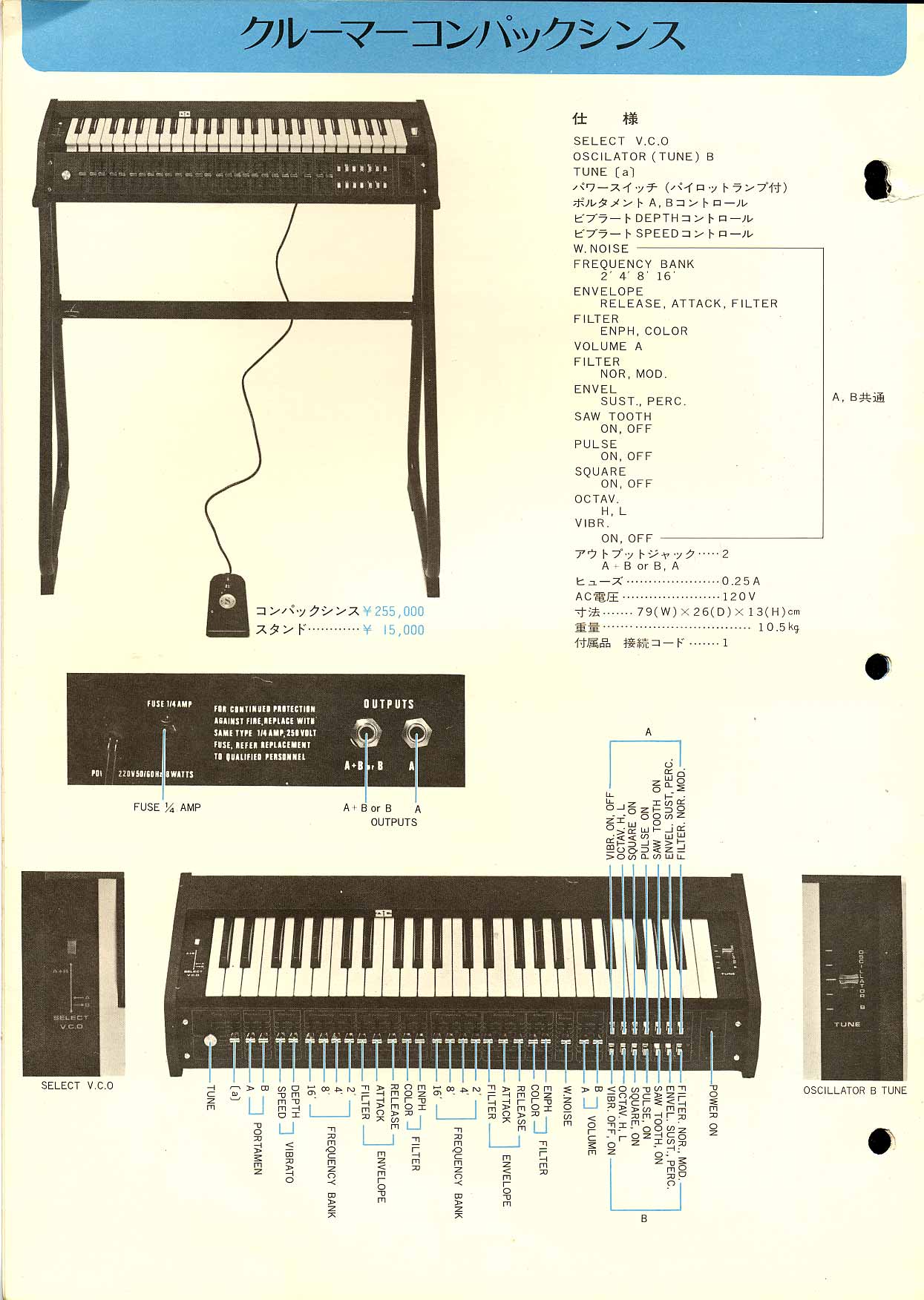
 Waar is de COMPAC SYNTH gebleven. Ik had deze synth in mijn bandje (1976) maar je komt ze zelden meer tegen en zelfs plaatjes zijn ver te zoeken.