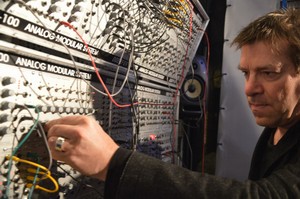
The Art of Electronics

Voor Pronixia, een Zweeds pionier:

Rune Lindblad
(Born 12 May 1923 in Gothenburg – 5 May 1991) was a Swedish composer of Musique concrète and electronic music, and visual artist.

He first began composing in 1953 and composed over 200 works.
His first piece, "Party", is considered the first electroacoustic work created in Sweden.
For three years he experimented with optics and sound, and produced five works using over 1800 meters of film.
On 14 February 1957, Lindblad, Sven-Eric Johansson, and Bruno Epstein put on the first concert of concrète and electronic music in Sweden at the Folkets hus in Gothenburg. The audience responded poorly and demanded refunds, critics referred to the music as "pure torture".

"Glaciär from Predestination, Proprius", 1975:
http://youtu.be/DMmHPKurz2Y

ps: Het was voor mij enorm leuk om in de Lindblad studio, Gotenborg masterclasses te mogen geven.
 

Attachments

  • Rune Lindblad.jpg
    Rune Lindblad.jpg
    14,4 KB · Bekeken: 155
Tod Dockstader

Tod Dockstader (born March 20, 1932 in Saint Paul, Minnesota) is an American composer of electronic music, and particularly musique concrète. He studied painting and film while at the University of Minnesota, before moving to Hollywood in 1955, to become an apprentice film editor. He moved into work as a sound engineer in 1958, and apprenticed at Gotham Recording Studios, where he first started composing. Dockstader's first record, Eight Electronic Pieces, was released in 1960, and was later used as the soundtrack to Federico Fellini's Satyricon (1969). He continued to create music throughout the first half of that decade, working principally with tape manipulation effects. In 1966 Owl Records released four albums of his work from this period including what many consider to be Dockstader's masterpiece, "Quatermass".

"Apocalypse part II", 1961:
 

Attachments

  • dockstader1.jpg
    dockstader1.jpg
    17,9 KB · Bekeken: 156
Luc Ferrari
(February 5, 1929 – August 22, 2005)

Luc Ferrari was born in Paris, and was trained in music at a very young age, studying the piano under Alfred Cortot, musical analysis under Olivier Messiaen and composition under Arthur Honegger. His first works were freely atonal. A case of tuberculosis in his youth interrupted his career as a pianist. From then on he mostly concentrated on musical composition. During this illness he had the opportunity to become acquainted with the radio receiver, with pioneers such as Schönberg, Berg, and Webern.

In 1954, Ferrari went to the United States to meet Edgard Varèse, whose Déserts he had heard on the radio, and had impressed him. This seems to have had a great effect on him, with the tape part in Déserts serving as inspiration for Ferrari to use magnetic tape in his own music. In 1958 he co-founded the Groupe de Recherches Musicales with Pierre Schaeffer and François-Bernard Mâche. He taught in institutions around the world, and worked for film, theatre and radio. By the early 1960, Ferrari had begun work on his Hétérozygote, a piece for magnetic tape which uses ambient environmental sounds to suggest a dramatic narrative. The use of ambient recordings was to become a distinctive part of Ferrari's musical language.

Ferrari's Presque rien No. 1 'Le Lever du jour au bord de la mer' (1970) is regarded as a classic of its kind. In it, Ferrari takes a day-long recording of environmental sounds at a Yugoslavian beach and, through editing, makes a piece that lasts just twenty-one minutes. It has been seen as an affirmation of John Cage's idea that music is always going on all around us, and if only we were to stop to listen to it, we would realise this. Ferrari continued to write purely instrumental music as well as his tape pieces. He also made a number of documentary films on contemporary composers in rehearsal, including Olivier Messiaen and Karlheinz Stockhausen.(Wiki)

Etude aux accidents musique concrete tape music:
http://youtu.be/mg4HGRRj00s
 

Attachments

  • luc_ferrari.jpg
    luc_ferrari.jpg
    52,5 KB · Bekeken: 161
Lejaren Arthur Hiller
(February 23, 1924, New York City – January 26, 1994, Buffalo, New York)

was an American composer. In 1957 he collaborated on the first significant computer music composition, Illiac Suite, with Leonard Issacson. It was his fourth string quartet. In 1958 he founded the Experimental Music Studio at the University of Illinois at Urbana-Champaign. His notable pupils included composers James Fulkerson, Larry Lake, Ilza Nogueira, David Rosenboom, Bernadette Speach and James Tenney.
He played piano, oboe, clarinet, and saxophone as a child. He also studied composition with Roger Sessions and Milton Babbitt while earning his chemistry degree at Princeton University. His father, Lejaren Hiller, Sr., was a well-known art photographer who specialized in historical tableaux.
He wrote an article on the Illiac Suite for Scientific American which garnered a lot of attention from the press, generating a storm of controversy. The musical establishment was so hostile to this interloper scientist that both Baker's Biographical Dictionary of Musicians and the New Grove Dictionary of Music and Musicians refused to include him until shortly before his death.
A majority of Hiller's works after 1957 do not involve computers at all, but might include stochastic music, indeterminacy, serialism, Brahmsian traditionalism, jazz, performance art, folksong and counterpoint mixed together. He also collaborated with John Cage for HPSCHD. In 1968, he joined the faculty at University at Buffalo as Slee Professor of Composition, where he established the school's first computer music facility and codirected with Lukas Foss the celebrated Center of the Creative and Performing Arts. His illness forced him to retire in 1989.(Wiki)

Vocalise:
http://youtu.be/S_6fPZ6sY90
 

Attachments

  • Lejaren Hiller.jpg
    Lejaren Hiller.jpg
    45,5 KB · Bekeken: 167
Kenneth Gaburo
(July 5, 1926–January 26, 1993)

He became Director of the Experimental Music Studio at the University of Iowa in 1983.[citation needed] The studio put intensive focus on composition, technology, psycho-acoustic perception, performance, and the affirmation of the uniqueness of the individual to create his/her own language reality. At the studio, he founded the Seminar for Cognitive Studies, a forum for discussion of the creative process. His concern for the investigation of music as legitimate research, and composition as the creation of intrinsic appropriate language, led to a series of readings in compositional linguistics for solo performer.
He most often made innovative use of electronics and explored tonality, serialism, and what he called "compositional linguistics" such as in his LINGUA series (Listening). He also wrote minimal pieces such as The Flow of (u) for three voices singing unison.(Wiki)

For Harry, 1966:
http://youtu.be/Pl_hrsnVTpU
 

Attachments

  • kgmixer.jpg
    kgmixer.jpg
    37,3 KB · Bekeken: 158
Edgar Valcárcel Arze
(4 Dezember 1932 in Puno; † 11. März 2010 in Lima)

Valcárcel studied at the Academy of Music in Lima in Andres Sas Orchassal, at Hunter College (New York) with Donald Lybbert, at the Centro Latinoamericano de Altos Estudios Musicales (CLAEM) in Buenos Aires and at the Electronic Music Center of Columbia University in New York under Vladimir Ussachevski and Alcides Lanca. He was professor of composition at the Conservatory of Lima.
Valcárels output includes orchestral works, a piano, a cello and a clarinet concerto, chamber music in a different occupation, two piano sonatas, choral works, songs, stage music, and works for electronic instruments.(Wiki)

Invención,1966:
http://youtu.be/i8U7vULTqDM
 

Attachments

  • Edgar Valcarcel.jpg
    Edgar Valcarcel.jpg
    66,2 KB · Bekeken: 156
Charles Dodge
(b. Ames, Iowa, June 5, 1942)

is an American composer best known for his electronic music, specifically his computer music. He is a former student of Darius Milhaud and Gunther Schuller.
In the 1970s he taught at Columbia and subsequently founded the Brooklyn College Center for Computer Music (BC-CCM) at Brooklyn College of the City University of New York where he was Professor of Music. He also taught at the City University Graduate Center. During Dodge’s years as Professor of Composition and Director of the BC-CCM, Dodge not only had the BC-CCM designated as an official Center within Brooklyn College in 1978 but more importantly brought it to a world-class standing in the field of computer music.
In the early 1990s Dodge left Brooklyn College for Dartmouth College. In May 2009 he retired from the position of Visiting Professor at Dartmouth College, a post he held for 18 years. In addition to his work as a composer, Dodge is noted for co-authoring the highly praised book Computer Music: Synthesis, Composition, and Performance, ISBN 0-02-864682-7(Wiki)

Charles Dodge - Earth's Magnetic Field, Columbia-Princeton Electronic Music Center 1961-1973 compilation:
http://youtu.be/j5MHsnc67yw
 

Attachments

  • Charles Dodge.jpg
    Charles Dodge.jpg
    12,4 KB · Bekeken: 168
Electronic Frequencies II

Electronic Frequencies II

Ik ben net weer als gast gevraagd voor het programma Electronic Frequencies op de concertzender. Voor de uitzending 30 oktober. Direct, en anders later als streaming te beluisteren. Wanneer ik het concept voor deze uitzending klaar heb laat ik dit weten.
 
Ik ben net weer als gast gevraagd voor het programma Electronic Frequencies op de concertzender. Voor de uitzending 30 oktober. Direct, en anders later als streaming te beluisteren. Wanneer ik het concept voor deze uitzending klaar heb laat ik dit weten.

Fijn, ik kijk er alvast naar uit. Vorige keer -- The Art of Electronics op 29 mei -- was voor mij erg boeiend.

Intussen even opgezocht. Ik ga dit weekend alvast The Art of Electronics nog eens beluisteren:

Deel 1
Deel 2

En blijkbaar was er ook nog:

Deel 3
Deel 4
Deel 5
 
@Hover, bedankt, allemaal sonic treasures!

Alvin Lucier
(born May 14, 1931) is an American composer of experimental music and sound installations that explore acoustic phenomena and auditory perception. A long-time music professor at Wesleyan University, Lucier was a member of the influential Sonic Arts Union, which included Robert Ashley, David Behrman, and Gordon Mumma. Much of his work is influenced by science and explores the physical properties of sound itself: resonance of spaces, phase interference between closely tuned pitches, and the transmission of sound through physical media.
Though Lucier had composed chamber and orchestral works since 1952, the composer and his critics count his 1965 composition Music for Solo Performer as the proper beginning of his compositional career. In that piece, EEG electrodes attached to the performer’s scalp detect bursts of alpha waves generated when the performer achieves a meditative, non-visual brain state. These alpha waves are amplified and the resulting electrical signal is used to vibrate percussion instruments distributed around the performance space. Other important early pieces include Vespers (1968, in which performers use hand-held echolocation devices to locate the approximate physical centre of a room, to deepen their understanding of acoustical perception, and to reveal the elements of environmental space through non-visual means.

I Am Sitting in a Room

One of Lucier’s most important and best-known works is I Am Sitting in a Room (1969), in which Lucier records himself narrating a text, and then plays the recording back into the room, re-recording it. The new recording is then played back and re-recorded, and this process is repeated. Since all rooms have a characteristic resonance (e.g., between a large hall and a small room), the effect is that certain frequencies are gradually emphasized as they resonate in the room, until eventually the words become unintelligible, replaced by the pure resonant harmonies and tones of the room itself. The recited text describes this process in action. It begins, “I am sitting in a room, different from the one you are in now. I am recording the sound of my speaking voice…”, and concludes with “I regard this activity not so much as a demonstration of a physical fact, but more as a way to smooth out any irregularities my speech might have,” referring to his own stuttering.(Wiki)

Alvin Lucier - I Am Sitting In A Room:
http://youtu.be/2jU9mJbJsQ8

Lucier-Music for Piano and Oscillators:
http://youtu.be/B14Pspjok78
 

Attachments

  • Alvin+Lucier++Photo+by+Bob+Anta.png
    Alvin+Lucier++Photo+by+Bob+Anta.png
    171,3 KB · Bekeken: 155
concept

Thema-avonden: The Art Of Electronics / 100 jaar elektronische muziek:

Woensdag 30 oktober laat sound-designer Roland Kuit ons de randen van geluid ervaren. Wanneer wordt klank/geluid/lawaai/trilling compositie? Beginnend met P. Henry's compositie "Variations pour une porte et un soupir" uit 1963, zet Kuit de deur open voor het ervaren van boeiende experimenten en brengt hij ons terug naar de essentie van een trilling. Welke toegepaste elektronische technieken waren de afgelopen jaren 'groundbreaking'? Welke sound-designers konden hun vindingen vertalen naar esthetisch verantwoorde composities?
 
Henri Pousseur
(23 June 1929, Malmedy – 6 March 2009, Brussels) was a Belgian composer.

Pousseur studied at the Academies of Music in Liège and in Brussels from 1947 to 1952, where he joined the group called Variations associated with Pierre Froidebise. It was in this group that he first became familiar with the music of Anton Webern and other 20th-century composers. During his period of military service in 1952–53 at Malines he maintained close contact with André Souris. He encountered Pierre Boulez in 1951 at Royaumont, and this contact inspired his Trois chants sacrés, composed that same year. In 1953 he met Karlheinz Stockhausen, and in 1956 Luciano Berio (Decroupet 2009).
Beginning around 1960, he collaborated with Michel Butor on a number of projects, most notably the opera Votre Faust, 1960–68 (Decroupet 2009).
Pousseur taught in Cologne, Basel, and in the United States at SUNY Buffalo, as well as in his native Belgium. From 1970 until his retirement in 1988 he taught at the University and Conservatory of Liège where he also founded the Centre de recherches et de formation musicales de Wallonie.(Wiki)

Henri Pousseur: Huit Etudes paraboliques, I. Les Ailes d'Icare, 1972:
http://youtu.be/qefjl71J11w
 

Attachments

  • Henry Pousseur.jpg
    Henry Pousseur.jpg
    4,7 KB · Bekeken: 151
Charles Wuorinen

born June 9, 1938, is a prolific Pulitzer Prize-winning American composer born and living in New York City. His catalog of more than 260 compositions includes works for orchestra, opera, and chamber music, as well as solo instrumental and vocal works. In recent years he has dedicated attention to large-scale works for the stage, including collaborations with Salman Rushdie and Annie Proulx.

The 1970s were a particularly fruitful period for Wuorinen, who taught from 1971 to 1979 at the Manhattan School of Music. Chamber works during this decade include his first two string quartets, the Six Pieces for Violin and Piano, Fast Fantasy for cello and piano and two large works for the Tashi ensemble, Tashi and Fortune. Works for orchestra include the Grand Bamboula for strings, A Reliquary for Igor Stravinsky which incorporates the elder master's last sketches, the Second Piano Concerto and the Concerto for Amplified Violin and Orchestra, which caused a scandal at its premiere at the Tanglewood Festival[1] with Paul Zukofsky and the BSO conducted by Michael Tilson Thomas. In 1976 Wuorinen completed his Percussion Symphony,[2] a five-movement work for 24 players including two pianos for the New Jersey Percussion Ensemble and his longtime colleague Raymond DesRoches, as well as his opera subtitled "a baroque burlesque", The W. of Babylon with an original libretto by Renaud Charles Bruce. In the late 1970s Wuorinen became interested in the work of the mathematician Benoit Mandelbrot and with a grant from the Rockefeller Foundation he conducted sonic experiments at Bell Labs in New Jersey. In an interview with Richard Burbank, Wuorinen is quoted as saying, "What I did at Bell Labs (with Mark Liberman) was to try various experiments in which strings of pseudo-random material, usually pitches but sometimes other things, were generated and then subjected to traditional types of compositional organization, including twelve-tone procedures. What I wanted to do was to see whether or not these things sounded "composed," sounded purposively chosen. They did, at least by my lights. The random sequences were not just any old random sequences but were that of a kind called 1/f randomness."(Wiki)


Charles Wuorinen: Time's Encomium. 1969:
http://youtu.be/CKqkBk_GA
 

Attachments

  • Charles W.jpg
    Charles W.jpg
    6 KB · Bekeken: 156
Delia Ann Derbyshire
(5 May 1937 – 3 July 2001) was an English musician and composer of electronic music and musique concrète. She is best known for her electronic realisation of Ron Grainer's theme music to the British science fiction television series Doctor Who and for her work with the BBC Radiophonic Workshop.

In November 1960 she joined the BBC as a Trainee Assistant Studio Manager and worked on Record Review, a magazine programme where critics reviewed classical music recordings. She said: "Some people thought I had a kind of second sight. One of the music critics would say "I don't know where it is, but it's where the trombones come in" and I'd hold it up to the light and see the trombones and put the needle down exactly where it was. And they thought it was magic." She then heard about the Radiophonic workshop and decided that was where she wanted to work. This was received with some puzzlement by the heads in Central Programme Operation because people were usually "assigned" to the Radiophonic Workshop, and in April 1962 she was indeed assigned to the BBC Radiophonic Workshop in Maida Vale, where for eleven years she would create music and sound for almost 200 radio and television programmes.

In August 1962 she assisted composer Luciano Berio at a two-week Summer School at Dartington Hall, for which she borrowed several dozen items of equipment from the BBC. One of her first works, and the most widely known, was her 1963 electronic realization of a score by Ron Grainer for the theme tune of the Doctor Who series, one of the first television themes to be created and produced by entirely electronic means.

When Grainer first heard it, he was so amazed by her rendering of his theme that he asked "Did I really write this?" to which Derbyshire replied "Most of it". Grainer attempted to get her a co-composer credit but the attempt was prevented by the BBC bureaucracy, who then preferred to keep the members of the Workshop anonymous. The theme was reworked over the years, to her horror, and the version that had her "stamp of approval" is her original one. Delia also composed some of the incidental music for the show, including Blue Veils and Golden Sands and The Delian (Wiki)

Delia Derbyshire-: "The Wizards Laboratory", 1972:
http://youtu.be/F9AkSI_UbIE
 

Attachments

  • delia-derbyshire.jpg
    delia-derbyshire.jpg
    37,4 KB · Bekeken: 153
Konrad Boehmer
(born 24 May 1941) is a Dutch composer and writer of German birth.

Boehmer was born in Berlin. His music reflects his Marxist political agenda, which is made explicit in many of his writings from the late 1960s and 1970s (e.g., Boehmer 1970). A self-declared member of the Darmstadt School (Boehmer 1987), he studied composition in Cologne with Karlheinz Stockhausen and Gottfried Michael Koenig, and philosophy, sociology, and musicology at the University of Cologne, where he received a PhD in 1966 (Sabbe 2001). After receiving his doctorate, he settled in Amsterdam, working until 1968 at the Institute for Sonology, Utrecht University. In 1972 he was appointed professor of music history and theory at the Royal Conservatory of The Hague (Sabbe 2001).

His compositions characteristically employ serial organization or montage, sometimes with elements of jazz and rock music (as in his opera Doktor Faustus and the electronic Apocalipsis cum figuris). In other works, such as Canciones del camino and Lied uit de vert Marxist songs serve as basic material (Sabbe 2001).

In 2001 the Holland Festival commissioned Boehmer to write a composition for the rock band Sonic Youth, which they performed at both concerts during that festival in the Stadsschouwburg Amsterdam (Sanders 2001). It was the band in its 'Goodbye 20th Century' period.(Wiki)

Konrad Boehmer: "Aspekt", 1966:
http://youtu.be/f_KWwiD33ac
 

Attachments

  • Konrad Boehmer.png
    Konrad Boehmer.png
    42,7 KB · Bekeken: 158
Denis Arthur Smalley
(born 1946 in Nelson, New Zealand)

is a composer of electroacoustic music, with a special interest in acousmatic music.
Denis Smalley studied at the University of Canterbury and Victoria University in his native New Zealand, and later at the Paris Conservatoire with Olivier Messiaen, with the Groupe de Recherches Musicales (GRM), and at the University of York, as well as the University of East Anglia in Norwich and the City University, London in England, where he has lived since 1971. He also studied with Musique concrète pioneer François Bayle.

He initially composed onto tape, but as early as the 1980s realised his works using computer software. His composition Pentes (1974) is regarded as one of the classics of electroacoustic music. Source sounds for his works may come from the environment—and are often the starting point for his pieces—but he may also develop highly sophisticated timbres from scratch using computer software. He describes his approach as "spectromorphological", featuring the development of sounds in time.

A lecturer at the University of East Anglia, England, from 1976 to 1994, he has been professor of music at City University, London since 1994.
His music has been performed around the world and most of his major works appear on commercially-released CDs.(Wiki)

Denis Smalley - Pentes, 1974:
http://youtu.be/uwYW02nf6WM
 

Attachments

  • PR_1988_denissmalley_001_m.jpg
    PR_1988_denissmalley_001_m.jpg
    52,2 KB · Bekeken: 169
Back
Top