Jim Aikin van Keyboard mag. zei er het volgende over:
Here's a mildly amusing anecdote for you:
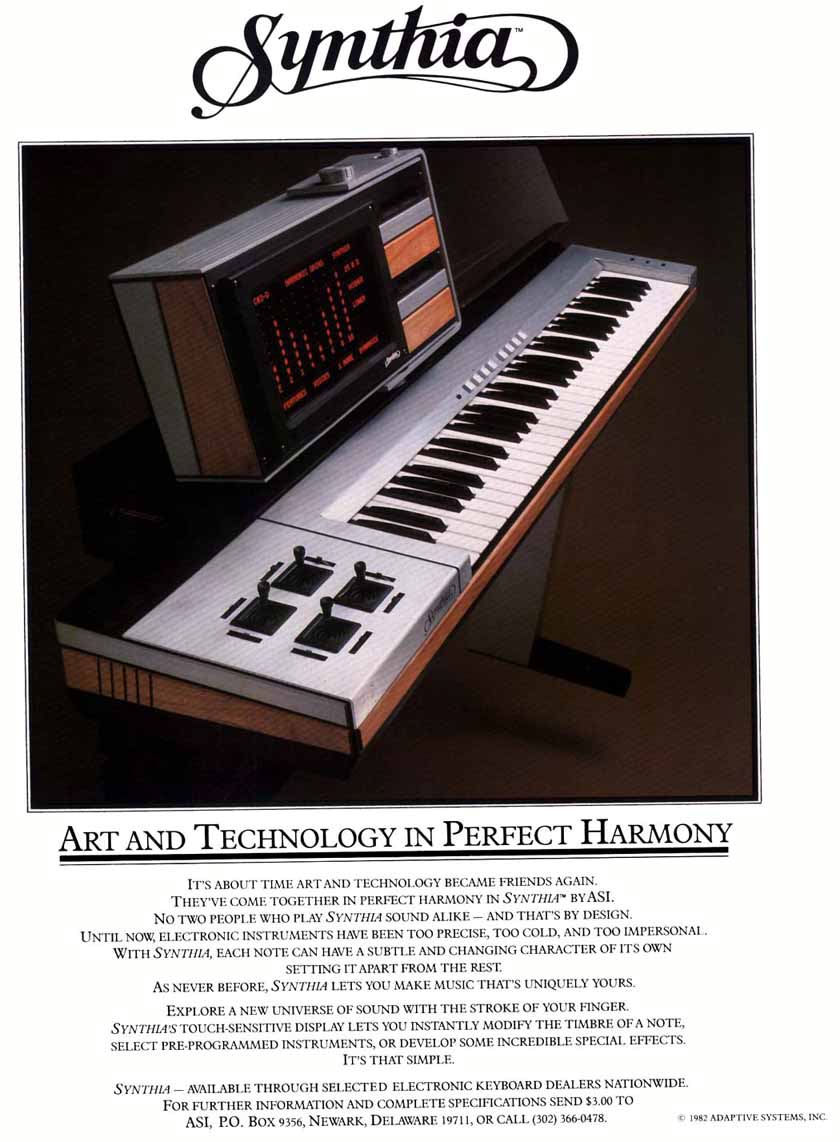
Once upon a time there was a little tiny company trying to market a high-end digital synth that would compete with the Fairlight and the Synclavier. It was called the Synthia, and it had a sexy touch-screen interface. The developers brought their prototype around to our office. This was just after the release of the DX7, so it would have been 1984 or thereabouts. The Synthia used additive synthesis based on a bank of sine waves -- rather like a Hammond organ, but with no balls whatever.
Wondering desperately whether I could somehow contrive to get an interesting sound out of this cheesebox, I asked them how fast they could crank up the LFO. I was thinking, if the LFO would go up into the audio range, at least you'd have a primitive form of FM. They obligingly pushed it up to the top of its range, which was about 20Hz. I played a chord on the keyboard.
When I let up on the keys, the sound continued for several seconds rather than stopping. Eventually the notes halted, one by one. I tried another chord. Same deal.
What was going on, I deduced, was that the designers were using one microprocessor to both scan the keyboard (sensing what keys were pressed) and generate the LFO waveform. At a fast LFO rate, the poor processor was so busy it didn't have time to check the keyboard for new notes.
After that, we never heard anything more about the Synthia.
Jim Aikin interview