Synthesizer Designers

Correctie / aanvulling van m'n 1e post

Correctie / aanvulling van m'n 1e post

Het lijkt er trouwens op dat ik gedeeltelijk de heren Wolfgang Palm en Axel Hartmann door elkaar gehaald heb. :z

Wolfgang Palm: PPG Modulars / Wave / Realizer, Waldorf MicroWave. Nu: Steinberg Plex.
00000075.jpg


Axel Hartmann: Waldorf MicroWave / Pulse / Wave / Q. Nu: Hartmann Neuron.
axel_hartmann.jpg


En dít is dus Tom Oberheim, eindelijk een werkende foto gevonden.
tomoberheim.gif


Ook nog een mooie foto van Alan R. Pearlman
alanrpearlman.jpg


Dave Smith
davesmith.gif


Chris Huggett
edp_chugget.gif
 
Laatst gewijzigd:
Galerij der Groten, deel 2

Galerij der Groten, deel 2

Ik was er natuurlijk nog een paar échte bikkels vergeten:

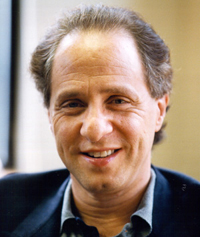
Ray Kurzweil (Kurzweil Music Systems)
Kurzweilportrait.jpg

Ray Kurzweil was the principal developer of the first omni-font optical character recognition, the first print-to-speech reading machine for the blind, the first CCD flat-bed scanner, the first text-to-speech synthesizer, the first music synthesizer capable of recreating the grand piano and other orchestral instruments, and the first commercially marketed large-vocabulary speech recognition. Ray has successfully founded and developed nine businesses in OCR, music synthesis, speech recognition, reading technology, virtual reality, financial investment, medical simulation, and cybernetic art. All of these technologies continue today as market leaders. Ray's Web site, KurzweilAI.net, is a leading resource on artificial intelligence.

Ray Kurzweil was inducted in 2002 into the National Inventors Hall of Fame, established by the U.S. Patent Office. He received the $500,000 Lemelson-MIT Prize, the nation's largest award in invention and innovation. He also received the 1999 National Medal of Technology, the nation's highest honor in technology, from President Clinton in a White House ceremony. He has also received scores of other national and international awards, including the 1994 Dickson Prize (Carnegie Mellon University's top science prize), Engineer of the Year from Design News, Inventor of the Year from MIT, and the Grace Murray Hopper Award from the Association for Computing Machinery. He has received eleven honorary Doctorates and honors from three U.S. presidents.

He has received seven national and international film awards. His book, The Age of Intelligent Machines, was named Best Computer Science Book of 1990. His current best-selling book, The Age of Spiritual Machines, When Computers Exceed Human Intelligence, has been published in nine languages and achieved the #1 best selling book on Amazon.com in the categories of "Science" and "Artificial Intelligence."


Dave Rossum (E-Mu Systems Modulars / Emulator, Solid State Music (SSM) synth-chips, Creative Labs SoundBlaster Live!)
daverossum.gif

Emulator Archives' beschrijving van de vroege E-mu dagen
Emu_Logo.jpg


En tot slot, voor de echte modulaire fans - de vrij onbekende modular pionier Serge Tcherepnin (Serge Modulars)
SERGTCH1.JPG


Mooie Serge fansite
Image24.gif


Serge gets its name from Serge Tcherepnin (pronounced "Cher - epp - nin"), a multitalented composer and electronic designer born of Russian-Chinese parents and raised in France. Self-taught in electronic design and circuit building, Serge enjoyed doing 'junk electronic' projects early on, making tape compositions using various electronic noisemakers cobbled together out of transistor radios and the like.

After studying music and physics at Harvard and Princeton, he taught music composition at the California Institute of the Arts. This was the early 70's, the heyday of Moog, ARP, and Buchla synthesizers. Calarts had a few Buchla-equipped studios. These were expensive, highly sought-after instruments, kept under lock and key. Getting studio time on one at Calarts meant being either a recognized staff composer or someone who maneuvered themselves into favor. The Buchla, ARP, and Moog synthesizers were interesting in their way, but could be improved upon. They were both expensive and bulky, a system with a decent number of functions could take up a whole wall in a small room. Serge and students Rich Gold and Randy Cohen wondered what they could do about this. After kicking around some ideas, they decided they were going to do their own synthesizer.

The first modules were designed, soldered, and built at Serge's home in what was essentially a kitchen tabletop operation. Before long, the word got out to other professors, students, and musicians about this new synthesizer. They wanted a piece of the action. Serge set up a strange sort of guerrilla manufacturing operation at Calarts on a second-story courtyard balcony. People paid $700 upfront for parts, worked on the 'assembly line' soldering and building modules, and eventually got themselves a six-panel system. Somehow, the Calarts administration either didn't find out or wasn't too bothered by this.

Another interesting player in this drama was composer Morton Subotnik, a professor at Calarts. He had a long association with instrument designer Don Buchla in the early 60's, the two of them collaborating on fundamental aspects of synthesizer design. When Mort spoke, Don listened. Serge caught on to this, and sought to woo Morton away from the Buchlas, but that was difficult. Eventually, Serge did build Mort some custom equipment.

In the 70's Serge collaborated on the design and construction of TONTO, a large polyphonic modular system. TONTO had the ancestry of many early Serge designs, some packaged behind faux-Moog front panels, including the NTO.

Serge eventually quit teaching and began to build synthesizers more seriously, using the first designs as a springboard. The Serge company was started in 1975, in the West Hollywood area, then headed north to San Francisco's Haight Street a few years later. It was always a humble bohemian concern, running more on enthusiasm and the love of making music than money and hardheaded business sense. Business tapered to a trickle in the middle 80's, and Serge, to support his family, started doing various outside electronic consulting projects. In 1992 Serge decided to move back to France. It was at this point that he sold the closely-guarded circuit designs to longtime associate Rex Probe, who then founded Sound Transform Systems. Production record keeping was pretty informal; it's estimated that "hundreds" of Serge systems were produced in the early years.

Today, Serge is again doing musical composition and is involved in helping Russian Jews move to Israel.

As Moog was a powerful East Coast influence that inspired ARP and Polyfusion, Buchla was the West Coast influence on Serge. Several Buchla designs, including the use of touch sensitive nontraditional keyboards, sequencers, random voltage generators, function generators, and matrix mixers found their way into Serge's repertoire. But that's not to say that Serge is merely a Buchla clone. Serge made many unique contributions, including the wave multiplier module, and some ideas were taken to new heights. Serge's oscillator designs have extraordinary accuracy and stability, especially considering their discrete nature. His philosophy of allowing the easy interplay of audio, control, and trigger signals, combined with the use of banana plugs, makes these systems wonderfully flexible.

There's no denying the amazing staying power of the Serge designs. Largely because of the development of convenient microprocessor-based keyboard synths, the 80's were a nasty time for analog synthesizer makers, practically all of them throwing in the towel. Serge's business slowed way down but never completely went out of production. With the recent clamoring for analog gear fueling successful production, Rex Probe and Sound Transform Systems look poised to carry the cream of analog modular music synthesis over the threshold of the 21st century, into their fourth decade of realization.
 
Laatst gewijzigd:
Origineel geplaatst door Hanz

Hartmann: MicroWave, Pulse, Wave, Q. Nu: Hartmann Neuron.
axel_hartmann.jpg

Niet helemaal correct. Axel is industrieel ontwerper (en synthesizerliefhebber) en als zodanig heeft hij vele mooie synths ontworpen.

De synthese van Neuron is echter ontwikkeld door Axels partner Stephan Bernsee.
 
@ Pim: bedankt voor de aanvulling. Dat soort dingen is vaak moeilijk precies te pinpointen voor een buitenstaander...
(zoals ik dus :D)

Zo heeft naar ik begrijp ook Wolfgang Düren mee-ontwikkeld aan de MicroWave.
Maar ik heb het even proberen te beperken tot een beperkt aantal "grote geesten" die aan een ruimere hoeveelheid synths hebben gewerkt, vandaar...
 
Ik kan er zo geen naam bij halen. Maar ik dacht me te kunnen herinneren dat aan de wieg van de Yamaha CS80 en DX1 een en dezelfde persoon stond. Zelfde gold dacht ik voor Korg Wavestation en Prophecy/Z1/Oasys. Weet iemand hier meer over? Ook Ben Kieto is naar mijn mening een invloedrijk Synth-designer.
 
Heb inderdaad begrepen dat het Oasys -> Prophecy & Z1 team ook verantwoordelijk was voor de Wavestation.
Aangezien de Wavestation is ontworpen door de R&D afdeling van Korg genaamd DSD (diezelfde van de Sequential Prophet VS) lijkt het me logisch dat het hier gaat om Dave Smith en kornuiten.

Volgens Sound-on-Sound is dit inderdaad het geval:
The main body of the VS development team was divided by Yamaha, but remained for some time under the direction of Dave Smith (the founder of Sequential Circuits, as Sequential were previously known). One half would eventually be responsible for the design and development of the Yamaha SY22 and SY35 vector synthesizers, both loosely based on the Prophet VS. The remainder of the team went to Korg, which had also been purchased by Yamaha at about the same time as Sequential. They went on to develop the Korg Wavestation series, evidently based on the Prophet VS, and quite possibly a classic synthesizer of tomorrow. In so doing, they solved some of the difficulties that had been associated with the programming of sounds on the Prophet VS by using 'wave tables' — though, as anybody who owns a Wavestation will tell you, it's still not a simple instrument to fully understand and learn. Vector synthesis is complicated stuff.

en

The roots of Korg's new OASYS PCI card lie in a project begun by Korg R&D in California during the early 1990s. That project, known as OASYS, was begun with the aim of developing a commercial instrument based on synthesis algorithms and architectures created using an in-house Mac software program called SynthKit in conjunction with a DSP card for real-time processing. Korg R&D's plans for OASYS were ambitious. They wanted to produce an open-architecture, DSP-based instrument that could be reconfigured in software to generate any available type of synthesis, with a front end built around a touch screen and a graphical user interface.

Het lijkt er wel op dat rond deze tijd Dave Smith inmiddels Korg R&D heeft verlaten.
Het nieuwe hoofd R&D van Korg California heet rond die tijd Dan Phillips...
oasysdanphillips.gif
 
zullen we rob papen ook maar in het rijtje zetten? :engel:
 
Prima Thread!
Hier ga ik voor, want het is toch mijn thema in het museum :)

Ik wil nog graag Hans Nordelius en Magnus Kjellander van Clavia toevoegen.
Die doen toch ook baanbrekend werk, vooral op dit moment.

Wout
 
Origineel geplaatst door hansbakker
zullen we rob papen ook maar in het rijtje zetten? :engel:

Hans, da's een Sound Designer, da's toch wat anders. Dan gebruik je een bestaande synth om geluiden op te ontwerpen.
En ja, dan doe ik net of ik niet weet dat Albino bestaat... (die heeft Rob toch ook niet met z'n eigen handjes geprogrammeerd?) :D
 
Origineel geplaatst door Wout Blommers
Ik wil nog graag Hans Nordelius en Magnus Kjellander van Clavia toevoegen.
Die doen toch ook baanbrekend werk, vooral op dit moment.

Wout, zeker jij mag je er niet zo gemakkelijk afmaken! ;)
Speciaal voor jou dan maar... Ikutaro Kakehashi (oprichter Ace-Tone, Roland), Bob Moog (Moog, Big Briar) en Hans Nordelius (Clavia):

kakehashimoognordelius2001.jpg
 
Hier nog meer legends;

EMU - Scott Wedge

Fairlight - Ron Vogel

NED Synclavier - Cameron Jones http://www.synclavier.com/CameronJones.html
Jon Appleton

SCI - John Bowen is nu bezig met softsynths voor Creamware inclusief de emulaties van de Prophet 5 en de Pro One.

Simmons Drums - Dave Simmons
 
Laatst gewijzigd:
Origineel geplaatst door Hanz
Wout, zeker jij mag je er niet zo gemakkelijk afmaken! ;)
Speciaal voor jou dan maar...

K-d-k-f-n-v...

(KonDatKutFotootjeNietVinden)

Wout :)
 
En mijn echte helden zijn natuurlijk Carla Scaletti en Kurt Hebel van het Kyma systeem.
 

Attachments

  • kyma260.jpg
    kyma260.jpg
    49,3 KB · Bekeken: 91
Uhmmm...kyma systeem?

Wat is dat?

Sid chip = Robert Yannes, veel info op internet, check google. Grappig omdat ze eigenlijk een chip hadden uitgevonden waarvan ze niet helemaal wisten wat het nou precies kon (en deed :D )
 
Origineel geplaatst door Pim
Is Neil Steiner al genoemd?. Hij is de uitvinder van de Steiner EVI.

NyleSteiner1980small.jpg


Nyle Steiner heet ie. ;) Ook de (technische) man achter onder meer de Steiner-Parker Synthacon, samen met Dick Parker die voor de behuizingen verantwoordelijk was.

De Steiner-Parker geschiedenis in een notendop vindt je hier.
En hier nog een site over EVI's en EWI's.
Nyle Steiner's EVI site is hier te vinden.

De laatste ontwikkeling van Nyle Steiner is de MIDI EVI.
 
Laatst gewijzigd:
Lev Thermen moesten we ook maar niet vergeten. Uitvinder van de Theremin, en daarmee oervader aller synthesizers.

Of moeten we daarvoor zijn bij Volta, Galvani en die knakkers?
 
Back
Top